A quarterly record of the U.S. copper telephone network's retirement: line counts,
regulatory actions, carrier notice trends, and impacted states. Every figure links to
its source.
Figure moved
The figure this link points to, , is published in the edition, which keeps its own page.
This quarter in short
The copper retirement has moved from filings to disconnections. AT&T says it has already discontinued copper service in more than 500 communities covering 1.3 million locations, and on November 15, 2026 it becomes authorized to do the same in portions of more than 1,000 wire centers across 19 states. Verizon has asked the FCC to retire copper POTS at about 750,000 locations in nine states and D.C. from November 30. The FCC’s newest count, released November 2, puts remaining switched-access lines at 13.5 million, down from 15 million six months earlier, and its streamlined retirement rules took full effect on October 15. AT&T’s 2027 waves are already approved. If fire alarm panels, elevator emergency phones, fax, or point-of-sale still run on copper, the notice is no longer the warning; it is the schedule.
AT&T publishes its Section 251 network-change notices, including copper retirements, on its CLEC Online Network Disclosures site; annual copper-retirement counts shown here are as tallied by MetTel (Copper Retirement Bulletin, October 2026), whose 2026 figure includes 442 notices received since January 1, 2026. The Q3 edition carried MetTel’s July tally of 824. DataRemote’s own check of AT&T’s Network Disclosures index on November 6, 2026 found 447 disclosures carrying a 2026 revision date, 428 of them copper retirements, spanning all 21 states in AT&T’s wireline footprint, with California (107) and Florida (56) the most frequent. The two series count different things (MetTel counts notices received; the index lists each disclosure once, by its latest revision date) and are not summed. Full DataRemote-derived tracking by notice type and wire center remains planned.
AT&T copper retirement notices per year, 2019 to 2026
Year
Notices
2019
16
2020
82
2021
97
2022
111
2023
145
2024
240
2025
494
2026
936
Key figures
The state of copper retirement, Q4 2026
Each figure carries its full context and the source it came from. Every card has its
own anchor, so a specific number can be linked directly.
13.5M
Traditional copper POTS lines still in service in the U.S.
The FCC’s Voice Telephone Services Report released November 2, 2026 counts 13.5 million end-user switched-access lines as of December 31, 2025, down from 15.0 million six months earlier and 24.4 million in December 2022. Over those three years the count fell at a compound annual rate of 17.9%. Interconnected VoIP subscriptions, at 61.8 million, also fell during the half, so the lines leaving copper are not simply moving to another wireline service.
Where AT&T is authorized to discontinue copper voice service on or after November 15, 2026
AT&T’s Section 214 applications, deemed granted January 12, 2026, authorize discontinuance of legacy POTS for approximately 90,000 customers in portions of more than 1,000 wire centers in 18 states on or after November 15, 2026; companion applications covering Remote Call Forwarding and copper-only AT&T Phone service add Illinois, and a further application deemed granted in September adds business POTS in six of those states for the same date (WC Docket No. 26-200). The replacement AT&T relies on is its own LTE-based voice service, with a built-in battery rated for up to 24 hours on standby.
Locations in Verizon’s application to discontinue copper POTS from November 30, 2026
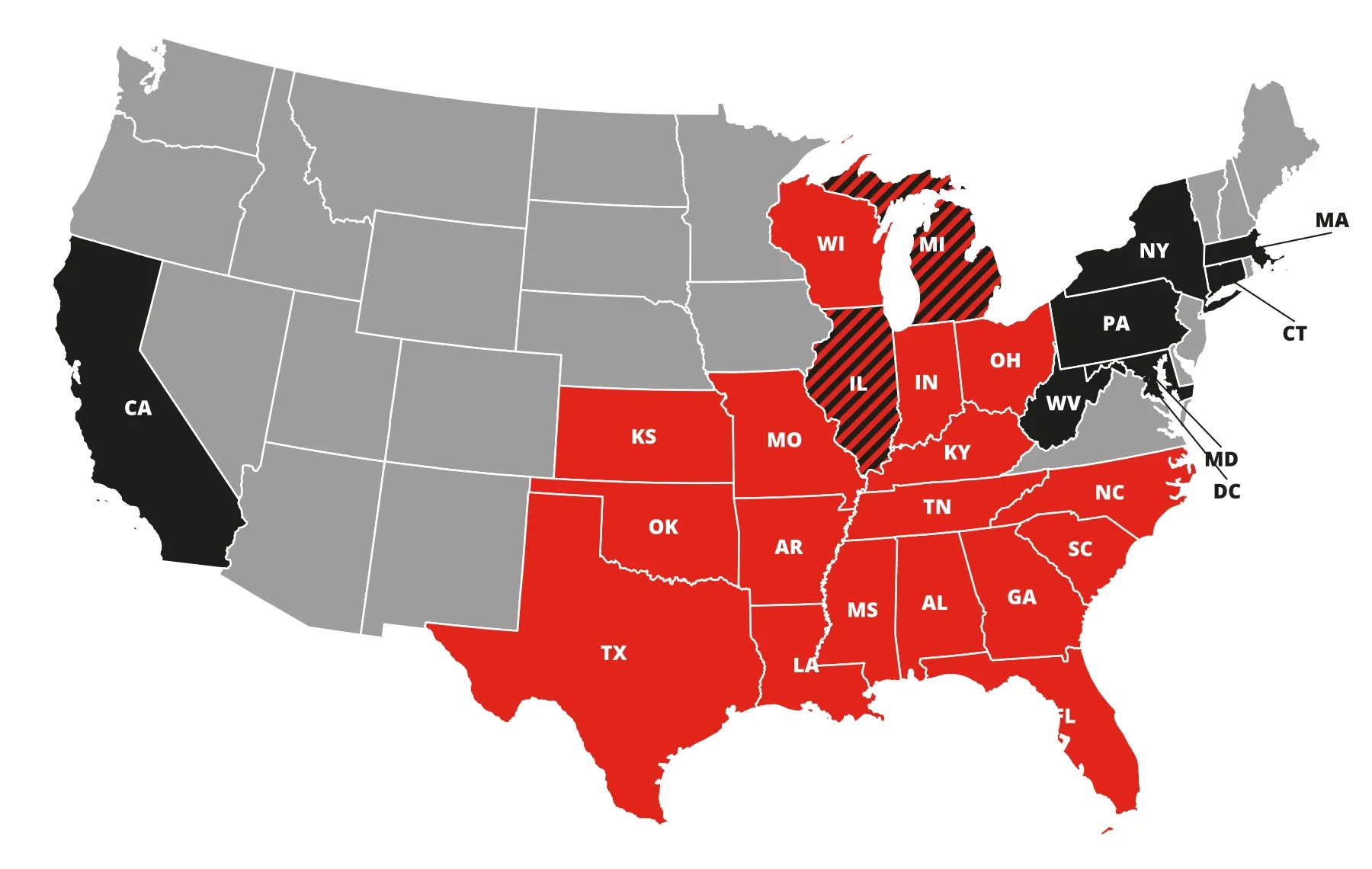
On September 9, 2026, Verizon and its former Frontier operating companies applied to the FCC to discontinue TDM-based POTS over copper in portions of California, Connecticut, the District of Columbia, Illinois, Maryland, Massachusetts, Michigan, New York, Pennsylvania, and West Virginia, on or after November 30, 2026. Verizon states its network could serve more than 28 million locations in these jurisdictions and that approximately 750,000, or 2.7%, still subscribe to legacy voice. As of November 6, 2026, the FCC had not released the public notice that starts the 31-day automatic-grant clock, so November 30 is Verizon’s requested date, not an authorized one.
Average monthly cost of an AT&T business copper access line, per AT&T
In the application behind the November 15 discontinuance, AT&T states that “on average, AT&T Business Local Exchange Access Line Service costs approximately $1,700 per month, plus taxes, surcharges, and fees,” against $99.99 for the wireless service it offers in its place. The same filing notes that the majority of customers pay an effective rate under $200, which is the point: the average is pulled up by the lines that remain on undiscounted legacy tariffs. MetTel continues to document rates above $3,300 per line across 10 states.
AT&T: 19 states with service discontinuance authorized on or after November 15, 2026 (WC Docket Nos. 25-333, 25-334, and 25-335). Verizon: nine states and D.C. in its September 9, 2026 application for discontinuance on or after November 30, 2026, which awaits FCC action. Affected areas are portions of wire centers, not whole states.
AT&T: the waves already approved for 2027
November 15 is the first of several AT&T discontinuances the FCC has already deemed granted. Further applications authorize discontinuance on or after January 29, 2027 in portions of 10 states (WC Docket No. 26-224); on or after June 1, 2027 in portions of 360 California wire centers serving approximately 184,000 residential and 15,000 business customers (WC Docket Nos. 26-120 and 26-121); and on or after September 1, 2027 in portions of 19 states including Nevada (WC Docket No. 26-210). A fourth, for portions of 14 states on or after April 2, 2027, went on public notice October 28 and is deemed granted November 28, 2026 unless the FCC acts (WC Docket No. 26-293). AT&T’s third-quarter report restates its goal of decommissioning the large majority of its copper network by the end of 2029.
Verizon: one application granted, one pulled from streamlined review
Verizon’s application for former Frontier areas in Florida, Indiana, Minnesota, Nebraska, Nevada, North Carolina, Texas, and Wisconsin (WC Docket No. 26-170) was deemed granted with discontinuance authorized on or after November 16, 2026. Its application for portions of Arizona, Delaware, New Jersey, New Mexico, Ohio, Rhode Island, South Carolina, Utah, and Virginia (WC Docket No. 26-227) was removed from automatic grant on September 25, 2026, after county objections over wireless coverage and 911 access; the FCC said it needs additional time to complete its review. Verizon states it will not discontinue copper voice at a location without an approved replacement.
AT&T service discontinuance authorized on or after November 15, 2026: 19 states
Portions of more than 1,000 AT&T wire centers. The legacy POTS application (WC Docket No. 25-335) covers 18 states and approximately 90,000 customers; companion applications for Remote Call Forwarding and copper-only AT&T Phone service (WC Docket Nos. 25-333 and 25-334) add Illinois. Affected areas are portions of the listed wire centers, not whole states; AT&T’s customer notices state that service is subject to disconnection on or after the authorized date. The same ILEC affiliates filed a further application on September 21, 2026 covering 19 states for discontinuance on or after September 1, 2027.
AL
AR
FL
GA
IL
IN
KS
KY
LA
MI
MO
MS
NC
OH
OK
SC
TN
TX
WI
Wire-center-level timing varies; confirm locations against your carrier's current notices.
Verizon copper POTS discontinuance proposed on or after November 30, 2026: nine states and D.C.
Verizon’s September 9, 2026 application covers residential and business TDM-based POTS over copper in portions of these jurisdictions, at locations where Verizon fiber, Verizon mobile wireless, Verizon’s fixed wireless POTS replacement, or a named third-party voice service is available. Customer notices were mailed September 8, 2026. The FCC had not released an acceptance public notice as of November 6, 2026, so no automatic-grant date has been set; the 10 jurisdictions are shown because the notices have already gone out.
CA
CT
DC
IL
MA
MD
MI
NY
PA
WV
Wire-center-level timing varies; confirm locations against your carrier's current notices.
AT&T’s own Discontinued TDM Service Areas workbook, retrieved by DataRemote on November 6, 2026, lists 100,512 location entries across 3,995 wire centers in 21 states, with effective dates through March 16, 2026. The state list is unchanged since the Q3 edition; the November 15 wave had not yet been added to the workbook at retrieval.
AL
AR
CA
FL
GA
IL
IN
KS
KY
LA
MI
MO
MS
NC
NV
OH
OK
SC
TN
TX
WI
Wire-center-level timing varies; confirm locations against your carrier's current notices.
AT&T’s California applications are deemed granted: discontinuance of residential and business legacy voice in portions of 360 wire centers, affecting approximately 184,000 residential and 15,000 business customers, authorized on or after June 1, 2027. The CPUC has since asked the full Commission to review the grant.
Verizon applies to discontinue copper POTS at approximately 750,000 locations in nine states and D.C. on or after November 30, 2026, pending FCC approval; customer notices were mailed the day before.
The FCC invites comment on AT&T’s next legacy POTS application, covering portions of 19 states including Nevada, with discontinuance authorized on or after September 1, 2027.
The FCC removes Verizon’s nine-state application (Arizona through Virginia, WC Docket No. 26-227) from automatic grant, stating that it requires additional time to complete its review and that the removal is not a determination on the merits.
The FCC 26-19 amendments to the network-change disclosure and discontinuance rules (47 CFR §§ 51.329, 51.333, 63.60–63.71, and 63.602) take effect following OMB approval, completing the streamlined framework adopted in March.
AT&T reports that only 1% of its eligible customers still use legacy copper voice service, that it has discontinued copper services in more than 500 communities covering more than 1.3 million locations across 18 states, and that it will upgrade customers across 1,500 more communities over the next year.
AT&T’s third-quarter results report legacy segment revenue down 24.5% year over year, restate the goal of decommissioning the large majority of its copper-based network by the end of 2029, and project legacy EBITDA turning negative after 2027 until copper operating costs are substantially eliminated.
The FCC invites comment on AT&T’s application to discontinue legacy POTS and copper-only AT&T Phone service in portions of 14 states on or after April 2, 2027; comments are due November 12 and the application is deemed granted November 28, 2026 unless the FCC acts.
FCC Chairman Carr circulates a draft order to preempt California’s carrier-of-last-resort rules as applied to AT&T’s federally authorized discontinuances (WC Docket No. 26-125). No vote date has been set.
The FCC releases the Voice Telephone Services Report for December 31, 2025: 13.5 million end-user switched-access lines, down from 15.0 million in June 2025.
AT&T’s application to discontinue PrimePath and other TDM business lines sold by its competitive affiliates across 34 states and D.C. is deemed granted, with discontinuance authorized on or after the same date.
Authorized date for AT&T’s discontinuance of legacy POTS, Remote Call Forwarding, and copper-only AT&T Phone service in portions of 19 states; AT&T’s notices state that service is subject to disconnection on or after this date.
The first large AT&T disconnection wave is no longer a forecast. Lines in the affected portions of 19 states are subject to disconnection from November 15, 2026, and the replacement AT&T relies on is its own LTE voice service with up to 24 hours of battery standby, which does not line-power the equipment on the far end.
02
Verizon’s filing shows how little copper is left and how fast the rest goes: about 750,000 of the 28 million locations it could serve with POTS in nine states and D.C. still subscribe, and all of them are proposed for discontinuance where a replacement is available. The FCC pulled a sister application from streamlined review over coverage and 911 objections, which slows a wave but does not reverse it.
03
The FCC’s streamlined rules are now fully in force. Since October 15, 2026, a technology-transition discontinuance is deemed granted 31 days after public notice, grandfathering needs no separate application, and the FCC asserts preemption of state rules that would delay a federally authorized retirement. A draft order preempting California’s carrier-of-last-resort rules is in circulation.
04
Rates on remaining copper lines keep rising. AT&T’s own application puts the average business access line at about $1,700 per month before discounts, and MetTel documents rates above $3,300 per line across 10 states. Support shrinks on the same curve: AT&T’s legacy segment revenue fell 24.5% year over year, its CEO told investors on October 21 that more than 100 wire centers now have no customers on legacy services, and it expects the segment to lose money after 2027 until copper operating costs are gone.
05
Copper retirement reaches beyond phones. Fire alarm panels, elevator emergency phones, security systems, fax, and point-of-sale lines are all affected. A disconnected life-safety line is also a code problem: it can block inspections and occupancy sign-off, or force paid fire-watch coverage until communication is restored.
06
Demand for replacement hardware and installation surges as each wave lands, and the 2027 waves are already approved: January 29 in 10 states, June 1 in California, September 1 in 19 states, with April 2 in 14 states on notice. AT&T’s stated target is copper discontinued in half its wire centers outside California by the end of 2027. Organizations that wait for their notice compete for equipment and scheduling with everyone else who waited.
Get ahead of it
How to prepare for copper decommissioning
1
Identify
Inventory every location, circuit, carrier, and legacy service, paying closest attention to the specialty lines that do not look like phones: fire panels, elevator phones, security systems, fax machines, point-of-sale, and modem-based telemetry.
2
Validate
Confirm the retirement notices, dates, and affected services with the carrier for each address. Discontinuance applies to portions of wire centers, so two sites in one city can be on different schedules.
3
Assess
Separate voice from life-safety, security, and other specialty applications. Each class has its own signaling needs, code requirements, and sign-off path.
4
Select
Match each application to compatible replacement hardware. Most replacement products have compatibility limits with analog signaling; life-safety endpoints need certified equipment and sign-off from your alarm company, elevator contractor, and the authority having jurisdiction.
5
Migrate
Schedule installations, testing, and cutovers ahead of the carrier’s date, not after it. Migrating on your own schedule is cheaper and calmer than migrating inside a notice window, and installation demand rises with every wave.
6
Verify
Test every line end to end, document completion for inspectors and insurers, and establish ongoing monitoring and support so a failed line is caught before the next inspection finds it.
DataRemote's POTS line replacement
keeps the analog interface and retires the copper underneath it. The differences that
matter for the lines this bulletin tracks:
Comparison of traditional copper POTS lines and DataRemote POTS IN A BOX® replacement appliances
Feature
Traditional copper POTS line
POTS IN A BOX®
Technology
TDM over copper pairs with an analog POTS handoff
Managed cellular (5G/LTE) or wired IP with the same analog RJ-11/FXS handoff
Use cases
Voice, alarms, elevators, fire panels, fax, point-of-sale
The same endpoints, preserved without replacing the equipment
Availability
Grandfathered and being retired; AT&T targets nationwide copper retirement by 2029
Available today over certified nationwide 5G/LTE networks
Monthly cost
Repricing upward as regulation winds down; documented rates above $3,300/month in some states
Predictable managed pricing, with savings up to 50%
Power outages
Central-office line power, degrading as copper plant ages
Integrated UPS battery backup of up to 48 hours, depending on model and load
Failover
Manual intervention and carrier tickets
Automatic cellular failover and dual-SIM carrier redundancy
Monitoring
None; faults surface when something fails
Real-time line status, alerts, and remote diagnostics via Ara
E-911
Fixed street address on file
E911 with GNSS geo-location on supported models and configurations
AT&T becomes authorized to stop providing legacy POTS, Remote Call Forwarding, and copper-only AT&T Phone service in the portions of wire centers listed in its applications across 19 states. Its customer notices say the service is subject to disconnection on or after that date, so the carrier chooses the day. Lines are not all cut at once, but none of them is safe after it.
How do I know whether my location is affected?
Discontinuance applies to portions of specific wire centers, not whole states. Check the carrier’s notice for the address, the application’s wire-center exhibit, and the ZIP-code lists carriers and their partners publish; then confirm with the carrier. Two sites in the same city can fall in different waves.
Is Verizon’s November 30 date final?
No. November 30, 2026 is the date Verizon requested in its September 9 application. As of November 6, 2026, the FCC had not released the public notice that starts the 31-day automatic-grant clock, and it removed a separate Verizon application from streamlined review in September. Verizon has told customers it will not discontinue copper voice at a location without an approved replacement; plan for the requested date and track the docket.
Which lines are most at risk?
Code-governed and business-critical specialty lines: fire alarm panels, elevator emergency phones, security systems, fax, and point-of-sale devices. These endpoints depend on analog signaling behaviors that generic VoIP adapters often do not preserve, and for life-safety lines the replacement must satisfy the applicable code and the authority having jurisdiction, not just provide dial tone.
How does DataRemote address copper retirement?
POTS IN A BOX® appliances present standard RJ-11 FXS ports locally and carry voice, fax, DTMF, and alarm signaling over managed cellular (5G/LTE) or wired IP, with integrated battery backup, automatic cellular failover, and E911 support on properly provisioned models and configurations. Every appliance is managed through the Ara platform for provisioning, real-time line status, alerts, and remote diagnostics, which is how deployments scale to thousands of sites.
How is this bulletin updated?
Quarterly. Each edition is a dated record: new editions are added and prior editions are archived unchanged, so a citation to a specific edition stays accurate. Every figure links to its source, and third-party tracking data is always attributed to the organization that produced it.
The layer underneath
Rules and terms behind these figures
Every number above is stated in someone else's units — a wire center, a notice
period, a code edition. These pages define them.
What the migration costs against what copper now costs.
How this bulletin is built
Methodology and sources
This edition compiles verified public data with primary sourcing wherever a primary record exists. Line counts and decline rates come from the FCC’s Voice Telephone Services Report released November 2, 2026; discontinuance authorizations, dates, states, and customer counts from the FCC’s Section 214 public notices and the carriers’ filed applications (AT&T’s via the Florida PSC courtesy copy, Verizon’s via the FCC’s ECFS), with the California figures as published by the CPUC; the rule effective date from the Federal Register; AT&T’s financial statements from its Form 8-K, its progress figures from its own October 19, 2026 blog post, and its 2027 target from the published transcript of its October 21 earnings call; and the discontinued service-area list and disclosure tally directly from AT&T’s own workbook and Network Disclosures index, retrieved and counted by DataRemote on November 6, 2026. Annual notice tallies and copper rate observations are attributed to MetTel’s Copper Retirement Bulletin (October 2026), and one regulatory development that has no public FCC document yet (the circulating California preemption order) is attributed to the trade press that reported it. No figure is estimated or modeled by DataRemote. Where a date is a carrier’s request rather than an FCC authorization, the text says so.
Reference this research
Citing this bulletin
Cite the Q4 2026 edition by its permanent URL below: it never changes, and later
editions publish at their own addresses. A specific figure can be cited by its card's
anchor. For the bulletin in general, link dataremote.com/resources/research/copper-retirement-bulletin, which
always carries the newest edition. A plain-markdown version
of this page is published at the same address with a .md
suffix. Suggested citation:
DataRemote, "Copper Retirement Bulletin," Q4 2026 edition, published November 6, 2026. https://dataremote.com/resources/research/copper-retirement-bulletin-q4-2026
Every quarter
All editions
Each edition keeps its own page and PDF, unchanged after publication; the newest is
also published at the bulletin's main address. New editions are published quarterly.
This bulletin is provided for general information and is not legal, regulatory, or code-compliance advice. Figures reflect their cited sources as of the data date shown above; confirm current requirements and timelines with the FCC, your carrier, and the authorities having jurisdiction over your systems. Final acceptance of any life-safety installation depends on the product model, endpoint compatibility, installation, configuration, code edition, and the authority having jurisdiction.
Compiled by Joseph Hill , Lead of Business Systems, Data & Automation, DataRemote
Still have analog lines on copper?
Tell us what's running on them and we'll map each line to a managed replacement before the retirement notice arrives.
We use analytics and visitor-identification cookies to understand how our guides are used
and which companies are researching POTS replacement. Decline and we'll load neither;
the site works exactly the same. You can change your answer any time via
Your Privacy Choices in the footer. Details:
cookie policy
and
privacy policy.