A quarterly record of the U.S. copper telephone network's retirement: line counts,
regulatory actions, carrier notice trends, and impacted states. Every figure links to
its source.
Q3 2026 edition
·
Published ·
Data as of
This quarter in short
The U.S. copper network is being retired faster than at any point since the transition began. About 15 million lines remain, and the count is falling roughly 18% a year. A copper retirement can now take effect on as little as 90 days of public notice. AT&T is approved to discontinue more than 30% of its copper footprint this year, and intends to exit most copper operations by the end of 2029. If fire alarm panels, elevator emergency phones, fax, or point-of-sale still run on copper, the planning window is set by the carrier, not you.
AT&T publishes its Section 251 network-change notices, including copper retirements, on its CLEC Online Network Disclosures site; annual copper-retirement counts shown here are as tallied by MetTel (Copper Retirement Bulletin, July 2026), whose 2026 figure includes 330 notices issued since January 1, 2026. DataRemote’s own check of AT&T’s disclosure listings on August 17, 2026 found more than 580 network-change disclosures listed for 2025 alone, consistent with the acceleration shown. Full DataRemote-derived tracking by notice type is planned for a future edition.
Key figures
The state of copper retirement, Q3 2026
Each figure carries its full context and the source it came from. Every card has its
own anchor, so a specific number can be linked directly.
15M
Traditional copper POTS lines still in service in the U.S.
The FCC counted 15.0 million end-user switched-access lines as of June 30, 2025, down from 27.2 million in mid-2022. That is a compound annual decline of 17.9%: the subscriber base roughly halves every four years while the network behind it still has to be maintained.
How little notice a copper retirement now requires
Under the FCC’s streamlined network-change rules, a carrier’s copper retirement can take effect in as little as 90 days after public notice. The FCC’s March 2026 order (FCC 26-19) went further for service discontinuance, creating a uniform 31-day automatic-approval window for discontinuance applications and asserting preemption of state rules that would delay a federally authorized retirement.
Share of AT&T’s copper footprint approved for discontinuance in 2026
In January 2026, reporting on FCC approvals showed AT&T authorized to discontinue service across more than 30% of its copper footprint within the year, the largest single-year expansion of its retirement program to date.
Documented monthly rates on remaining copper lines
With legacy price regulation wound down, carriers are repricing the copper lines that remain. MetTel’s Copper Retirement Bulletin documents rates climbing to more than $3,300 per line per month across 10 states, with increases expected to continue until the lines are retired.
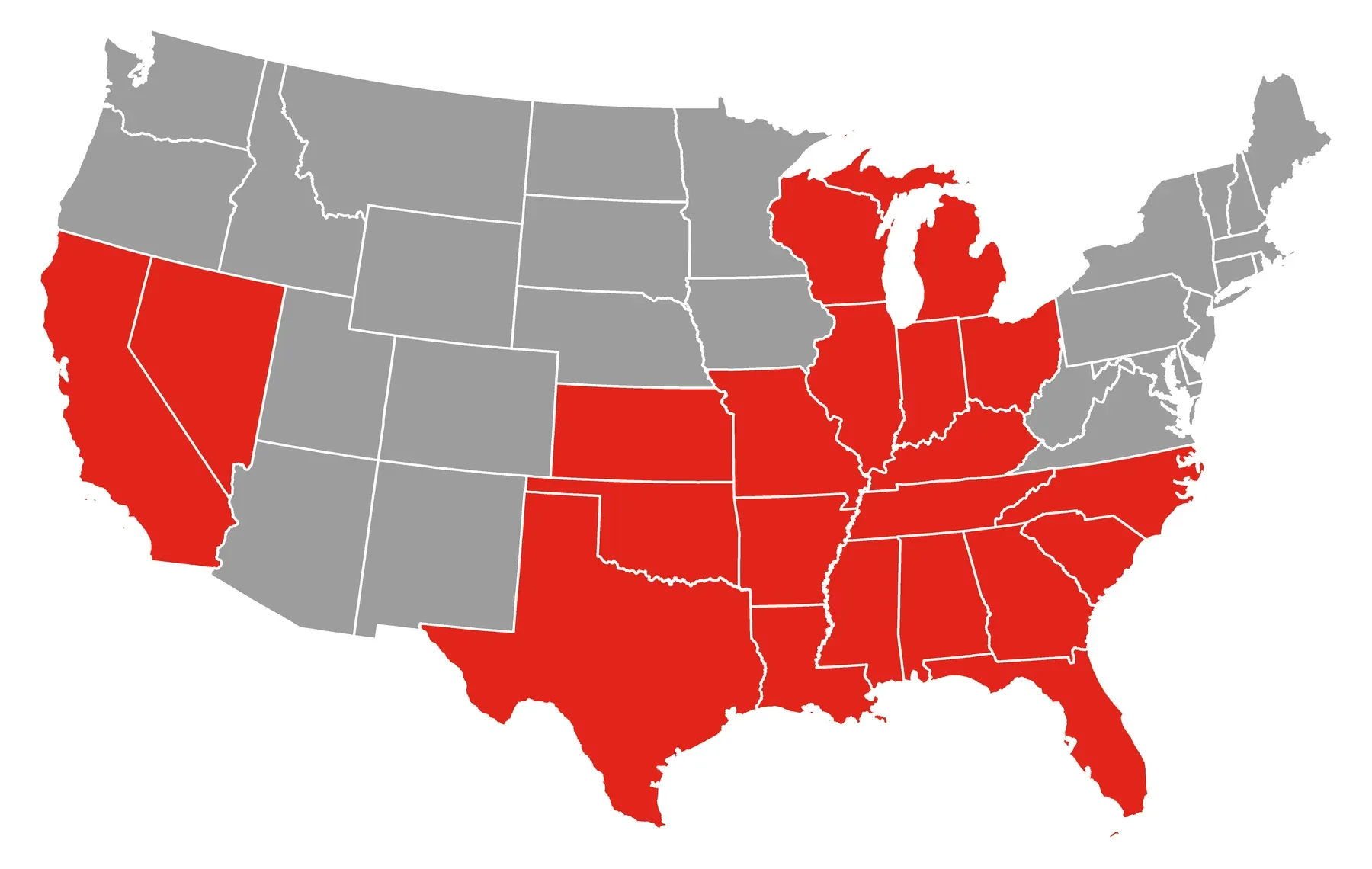
21 states with AT&T discontinued service areas, per AT&T's own workbook: more than
100,000 location entries, with CA, KS, and NV added since mid-2025.
AT&T grandfathering, effective October 15, 2025
AT&T grandfathered legacy copper voice and specialty-line services across its wire centers: no orders for new copper lines are accepted, while existing lines continue on rising rates until each wire center is retired. The underlying notices are published on AT&T’s CLEC Online Network Disclosures site.
Lumen: copper retirement across legacy CenturyLink states
Lumen closed new copper POTS orders across its legacy CenturyLink territory in 2025 and publishes rolling Rule 51.333 public notices of copper retirement covering wire centers in multiple states on its network-disclosures site.
AT&T’s own Discontinued Service Areas file, checked by DataRemote on August 17, 2026, lists more than 100,000 location entries across wire centers and distribution areas in 21 states, including three (CA, KS, NV) added since mid-2025:
AL
AR
CA (added since mid-2025)
FL
GA
IL
IN
KS (added since mid-2025)
KY
LA
MI
MO
MS
NC
NV (added since mid-2025)
OH
OK
SC
TN
TX
WI
Red outline marks states added since mid-2025. Wire-center-level timing varies;
confirm locations against your carrier's current notices.
The FCC adopts Report and Order FCC 26-19, streamlining copper retirement and legacy service discontinuance: a uniform 31-day automatic-approval window, grandfathering of legacy voice and low-speed data through customer notice, and asserted preemption of state or local rules that would delay a federally authorized retirement.
AT&T petitions the FCC to declare that California rules cannot impede full POTS discontinuance in the affected areas; the FCC opens the petition for public comment (WC Docket No. 26-125).
Support for copper central offices diminishes as retirement approaches. Repairs get slower and harder to schedule. That raises the odds of extended outages on the lines that remain.
02
Rates on remaining copper lines have risen steadily for a decade, and are expected to keep rising until the lines are retired. Documented cases now exceed $3,300 per line per month.
03
The timeline is compressed at both ends. Full retirement notices have historically given customers 180 days to move, per MetTel’s tracking. Under the FCC’s streamlined rules, a retirement can take effect on as little as 90 days of public notice.
04
Carriers discontinuing voice service are no longer required to offer a stand-alone voice replacement. A bundled alternative can satisfy the requirement.
05
Copper retirement reaches beyond phones. Fire alarm panels, elevator emergency phones, security systems, fax, and point-of-sale lines are all affected. A disconnected life-safety line is also a code problem: it can block inspections and occupancy sign-off, or force paid fire-watch coverage until communication is restored.
06
Demand for replacement hardware and installation surges as each wave of notices lands. Organizations that wait for their notice compete for equipment and scheduling with everyone else who waited.
Get ahead of it
How to prepare for copper decommissioning
1
Inventory your copper-based services
List every copper line and what runs on it, paying closest attention to safety-critical and business-critical specialty lines: fire panels, elevator phones, security systems, fax machines, and point-of-sale devices.
2
Match each endpoint to compatible replacement hardware
Most replacement products have compatibility limits with analog signaling. Life-safety endpoints need certified equipment and sign-off from your alarm company, elevator contractor, and the authority having jurisdiction.
3
Plan the transition before the notice arrives
Migrating on your own schedule is cheaper and calmer than migrating inside a notice window, and installation demand rises with every notice wave. Verify each line’s replacement before the copper is disconnected.
DataRemote's POTS line replacement
keeps the analog interface and retires the copper underneath it. The differences that
matter for the lines this bulletin tracks:
Comparison of traditional copper POTS lines and DataRemote POTS IN A BOX® replacement appliances
Traditional copper POTS line
POTS IN A BOX®
Technology
TDM over copper pairs with an analog POTS handoff
Managed cellular (5G/LTE) or wired IP with the same analog RJ-11/FXS handoff
Use cases
Voice, alarms, elevators, fire panels, fax, point-of-sale
The same endpoints, preserved without replacing the equipment
Availability
Grandfathered and being retired; AT&T targets nationwide copper retirement by 2029
Available today over certified nationwide 5G/LTE networks
Monthly cost
Repricing upward as regulation winds down; documented rates above $3,300/month in some states
Predictable managed pricing, with savings up to 50%
Power outages
Central-office line power, degrading as copper plant ages
Integrated UPS battery backup of up to 48 hours, depending on model and load
Failover
Manual intervention and carrier tickets
Automatic cellular failover and dual-SIM carrier redundancy
Monitoring
None; faults surface when something fails
Real-time line status, alerts, and remote diagnostics via Ara
E-911
Fixed street address on file
E911 with GNSS geo-location on supported models and configurations
POTS (Plain Old Telephone Service) replacement is the migration of analog copper telephone lines to a managed cellular or IP connection using an on-site appliance that presents the same analog interface, so the connected equipment keeps operating unchanged. It preserves the line while retiring the copper underneath it, which is what keeps fire panels, elevator phones, fax machines, and point-of-sale devices working without being replaced.
When do I need to act?
Before your notice arrives. Grandfathering already blocks new copper orders across much of the AT&T and Lumen footprints, retirement notices are accelerating year over year, and a retirement can take effect on as little as 90 days of public notice under the FCC’s streamlined rules. Organizations that migrate on their own schedule avoid the pricing, scheduling, and compliance pressure of migrating inside a notice window.
Which lines are most at risk?
Code-governed and business-critical specialty lines: fire alarm panels, elevator emergency phones, security systems, fax, and point-of-sale devices. These endpoints depend on analog signaling behaviors that generic VoIP adapters often do not preserve, and for life-safety lines the replacement must satisfy the applicable code and the authority having jurisdiction, not just provide dial tone.
How does DataRemote address copper retirement?
POTS IN A BOX® appliances present standard RJ-11 FXS ports locally and carry voice, fax, DTMF, and alarm signaling over managed cellular (5G/LTE) or wired IP, with integrated battery backup, automatic cellular failover, and E911 support on properly provisioned models and configurations. Every appliance is managed through the Ara platform for provisioning, real-time line status, alerts, and remote diagnostics, which is how deployments scale to thousands of sites.
How is this bulletin updated?
Quarterly. Each edition is a dated record: new editions are added and prior editions are archived unchanged, so a citation to a specific edition stays accurate. Every figure links to its source, and third-party tracking data is always attributed to the organization that produced it.
The layer underneath
Rules and terms behind these figures
Every number above is stated in someone else's units — a wire center, a notice
period, a code edition. These pages define them.
What the migration costs against what copper now costs.
How this bulletin is built
Methodology and sources
This edition compiles verified public data with primary sourcing wherever a primary record exists. Line counts and decline rates come from the FCC’s Voice Telephone Services Report; regulatory actions from FCC orders and public notices (FCC 26-19, DA 26-520, and the Section 251 network-change rules); footprint approvals from cited independent reporting; carrier retirement and grandfathering notices from the venues where carriers publish them (AT&T CLEC Online Network Disclosures; Lumen’s Rule 51.333 public notices); and the discontinued-service-area state list directly from AT&T’s own Discontinued Service Areas workbook, retrieved and reviewed by DataRemote on August 17, 2026. Annual notice tallies and copper rate observations are attributed to MetTel’s Copper Retirement Bulletin, the only published source for those series. No figure is estimated or modeled by DataRemote. Full DataRemote-derived notice tracking by type and wire center is planned for a future edition and will be published with its method.
Reference this research
Citing this bulletin
This page is the canonical, stable URL for the bulletin. Link to it directly, or to a
specific figure using its card's anchor. A plain-markdown version
of this edition is published at the same address with a .md
suffix. Suggested citation:
DataRemote, "Copper Retirement Bulletin," Q3 2026 edition, published August 17, 2026. https://dataremote.com/resources/research/copper-retirement-bulletin
Past quarters
Edition archive
Q3 2026
This is the first edition. New editions are published quarterly; prior editions
are archived here unchanged.
This bulletin is provided for general information and is not legal, regulatory, or code-compliance advice. Figures reflect their cited sources as of the data date shown above; confirm current requirements and timelines with the FCC, your carrier, and the authorities having jurisdiction over your systems. Final acceptance of any life-safety installation depends on the product model, endpoint compatibility, installation, configuration, code edition, and the authority having jurisdiction.
Compiled by Joseph Hill , Lead of Business Systems, Data & Automation, DataRemote
Still have analog lines on copper?
Tell us what's running on them and we'll map each line to a managed replacement before the retirement notice arrives.
We use analytics and visitor-identification cookies to understand how our guides are used
and which companies are researching POTS replacement. Decline and we'll load neither;
the site works exactly the same. You can change your answer any time via
Your Privacy Choices in the footer. Details:
cookie policy
and
privacy policy.