Nurse Call and Panic Buttons After Copper: A 90X1 Use Case
Direct Answer
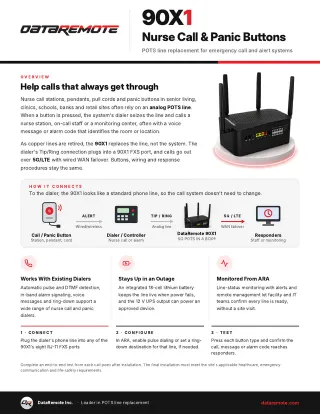
Nurse call stations, pendants, pull cords, and panic buttons in senior living, clinics, schools, banks, and retail sites often rely on an analog POTS line. When a button is pressed, the system’s dialer seizes the line and calls a nurse station, on-call staff, or a monitoring center, usually with a voice message or an alarm code that identifies the room or location. When that copper line is retired, the DataRemote 90X1 replaces the line, not the system. The dialer’s Tip/Ring connection plugs into a 90X1 FXS port, the call goes out over 5G/LTE with wired WAN failover, and the buttons, wiring, and response procedures stay the same. This post covers how these dialers use the line, what to check before you order, and how to test each call point. The one-page summary is available as a PDF white paper.
Key Takeaways
- Replace the line, not the system. The call points talk to their controller over the facility’s own wiring or radio. Only the dialer’s phone line moves, and the 90X1 presents one that behaves like copper.
- Three dialer behaviors, all supported. Voice-message auto-dialers, alarm-code dialers that report to a monitoring center, and ring-down lines to a nurse station each need something different from the line. The 90X1 provides pulse and DTMF detection, in-band alarm signaling, voice, and ring-down.
- Responders see no change. Staff phones and monitoring centers receive the same message or alarm code they do today, and the response procedure stays as written.
- Outages are covered on the line side. An integrated 18-cell lithium battery keeps the line live when power fails, and a 12 V UPS output can power an approved device. The controller’s own power still needs its own plan.
- Lines are supervised. Ara line-status monitoring and alerts let facility and IT teams confirm a line is ready without a site visit, which a copper pair never offered.
- Test every button type. The acceptance test is a real press of each station, pendant, cord, and panic button, confirmed by the people who answer.
The use case at a glance
| Detail | This use case |
|---|---|
| Endpoints | Nurse call stations, bedside and bathroom pull cords, wearable pendants, and fixed or portable panic buttons |
| Where found | Senior living and long-term care, clinics and outpatient sites, schools, bank branches, and retail stores |
| Line today | One analog POTS line per dialer, carrying a voice message, an alarm code, or a ring-down call to the people who respond |
| Product | DataRemote 90X1 5G POTS IN A BOX®, up to eight dialers per appliance |
| Transport | 5G/LTE, with wired WAN failover where the site has a wired internet connection |
| Answer point | A nurse station, on-call staff, or a monitoring center, unchanged |
| What stays the same | The call points, their wiring, the dialer, the message or alarm code, and the response procedure |
| Management | Ara: pulse dialing or ring-down destination per line, line-status monitoring, alerts, remote management |
How a nurse call or panic system uses its POTS line
These systems have two halves, and only one of them touches the phone line. The call points are the stations, cords, pendants, and buttons that people press. They report to a controller over the building’s own wiring or a short-range radio link, and that part is not affected by copper retirement at all. The controller’s dialer is the half that depends on the line. When a call point is activated:
- The controller registers the call and decides who needs to know, by room, zone, or button type.
- The dialer seizes the line. It goes off-hook, draws loop current, and, on a shared line, uses line seizure to take the pair ahead of any phone on it.
- It dials and delivers. Older dialers pulse the number; most send DTMF digits. What follows is a voice message, an alarm code, or an immediate ring-down connection, depending on the system.
- Responders act. A nurse answers a station call, an on-call aide gets a message naming the room, or a central station operator decodes a panic signal and dispatches police.
Three dialer behaviors and what each needs from the line
| Dialer behavior | What it sends | What the replacement line must preserve |
|---|---|---|
| Voice-message auto-dialer (senior living, small clinics, after-hours sites) | A recorded announcement naming the room or location, often to several numbers in sequence | Reliable dialing, a clean voice path, and correct detection of answer and hang-up so the dialer moves to the next number |
| Alarm-code dialer (panic and duress buttons in banks, retail, and schools; nurse call systems that report to a monitoring center) | An alarm format such as Contact ID, sent as DTMF tones that encode the event and the zone | In-band DTMF that arrives undistorted, plus the handshake and acknowledgement tones the receiver expects |
| Ring-down (hotline) (direct lines to a nurse station, security desk, or on-call phone) | Nothing is dialed; the line connects to a fixed destination the moment it goes off-hook | Hotline behavior configured on the line itself, so the connection happens without any digits |
The second row is the one that most often fails on a generic VoIP adapter. Alarm codes are tones inside the audio path, and anything that compresses or smooths that audio can corrupt them. Our guide to POTS replacement for fire and burglar alarm panels covers the same signaling in detail, because a panic button on an alarm panel reports exactly the way a burglar alarm does.
Why dial tone is not a test
A copper line gives no warning when it fails, and a nurse call dialer rarely tells anyone either. The stations still light, the controller still logs the call, and the dialer dutifully seizes a dead line. Facilities that discover the problem usually do so during a drill, or when a family asks why nobody came. Monitoring centers catch some of these failures through the dialer’s periodic test signal, where the system sends one, but a voice-message dialer calling staff phones has no such check. That silent-failure mode is the strongest reason to pair the replacement line with supervision, not only with a new carrier.
Why copper retirement reaches the nurse station
The copper line under a dialer is not being repriced. It is being withdrawn. The FCC’s guidance for government officials on network modernization explains that carriers are retiring copper and the legacy time-division multiplexing (TDM) switching behind it in favor of IP and wireless service, and that an incumbent carrier owes a non-residential customer at least 180 days’ notice before replacing that customer’s copper connection with fiber. The same guidance makes the point that matters most for an alarm dialer: copper landline service typically keeps working through a power outage, and the services that replace it usually need backup power of their own.
Those notices are already arriving. On January 12, 2026, AT&T’s application to discontinue legacy POTS in portions of 18 states was deemed granted under the FCC’s streamlined process, with discontinuance authorized on or after November 15, 2026; the dated record is in our newsroom: FCC grants AT&T applications to discontinue POTS in portions of 18 states. Verizon followed with a Section 214 application covering copper POTS in nine states and D.C. A dialer on either carrier’s copper has a date attached to it, whether or not the business office has forwarded the letter to the people who maintain the call system.
The rules these calls sit under
None of the rules below says how the call must travel. Each one says the call must get through, which is the property a migration has to prove.
| Setting | What the rule requires, and where it says so |
|---|---|
| Medicare and Medicaid certified long-term care facilities | A resident call system that relays the call directly to a staff member or a centralized staff work area from each resident’s bedside and from toilet and bathing facilities. Source: 42 CFR 483.90(g). |
| Hospital and nurse call equipment | UL 1069 is the UL standard for hospital signaling and nurse call equipment, covering the units that make up a fundamental nurse call system. Source: UL 1069. |
| Healthcare and social service workplaces | OSHA’s guidelines for preventing workplace violence list panic buttons among engineering controls, alongside barriers, metal detectors, lighting, and accessible exits. Source: OSHA 3148, Guidelines for Preventing Workplace Violence for Healthcare and Social Service Workers (PDF). |
| National banks | At minimum, an alarm system or other appropriate device for promptly notifying the nearest responsible law enforcement officers of an attempted or perpetrated robbery, burglary, or larceny. Source: 12 CFR 21.3(b)(4). |
Two cautions. UL 1069 addresses the nurse call equipment itself, not panic buttons or the phone line, so a listing on the system says nothing about the path its dialer uses. And the OSHA guidelines are recommendations, not a standard, though they are what a surveyor or insurer will reach for. Where a state licensing rule, a school-safety statute, or an insurer’s requirement also applies, the migration owes those parties the same proof: a documented test showing the call reached a responder. The requirements that govern emergency communication circuits more broadly are summarized on our emergency communication requirements page.
How the 90X1 connects to a nurse call or panic dialer
To the dialer, the 90X1 looks like a standard phone line, so the call system does not need to change. The appliance sits where the copper line terminated, usually the same closet or equipment room as the controller, and the dialer’s Tip/Ring connection plugs into one of the 90X1’s eight RJ-11 FXS ports. The call leaves over 5G/LTE. If the site has a wired internet connection on the 90X1’s WAN port, it serves as failover.
Three parts of the dialer’s behavior deserve a closer look, because they are where a replacement either preserves the workflow or breaks it.
Works with existing dialers
The 90X1 provides automatic pulse and DTMF detection, in-band alarm signaling, voice messages, and ring-down, which together cover the range of nurse call and panic dialers a facility is likely to have. In practice:
- A pulse-dialing controller from an earlier decade keeps its stored numbers. Pulse dialing can be enabled for that line in Ara where the dialer needs it. Automatic pulse and DTMF detection is available on the 90X1, 90X2, 90X5, and VAB-1, so a controller that pulses needs one of those models.
- An alarm-code dialer sends its DTMF tones through the audio path as it does on copper, and receives the handshake and acknowledgement tones from the monitoring center’s receiver.
- A ring-down line to a nurse station or security desk is configured with its destination in Ara, so going off-hook places the call with no digits dialed.
If several dialers share one copper pair today, decide during the inventory whether each gets its own 90X1 line. Separate lines remove the contention that line seizure exists to manage, and they let Ara report each dialer’s line on its own.
Stays up in an outage
Copper carried its own power from the central office. A replacement line does not, which is why the FCC’s note about backup power matters here. The 90X1 keeps the line live from an integrated 18-cell, 15 Ah lithium-ion battery rated for up to 48 hours of standby (actual runtime varies with usage), and its 12 VDC, 3.0 A UPS output can power an approved connected device. When the battery runs low, the appliance sends a battery alert and shuts down gracefully.
The controller is the other half of the outage question. Nurse call controllers and alarm panels usually have their own supply and often their own standby battery, sized to the hours their code or listing requires. Check both before cutover: a line that stays up for two days behind a controller that stops after four hours has not solved the problem. Our definition page on battery backup covers how to turn a standby rating into a runtime plan.
Monitored from Ara
The 90X1 is managed through Ara, DataRemote’s device management platform. For a nurse call or panic deployment, two Ara functions carry the weight:
- Line-status monitoring with alerts. Each 90X1 line reports its status, so a dialer that drops off the line raises an alert instead of waiting for the next drill.
- Remote management. Pulse dialing and ring-down destinations are set from the portal, and a line can be checked by the facility or IT team without a site visit.
Ara watches the line. It does not watch the dialer or the buttons, so keep the periodic test signal to the monitoring center running where the system sends one, and keep the scheduled button-press drill on the calendar.
Before you order: six questions for each dialer
Most of the work in this migration is in the inventory, not the installation. Answer these for every dialer on the property before sizing the order.
| Question | Why it matters |
|---|---|
| Does the system actually use a phone line? | Newer nurse call platforms report over the facility network and alert staff on mobile devices; some older ones use a phone line only for after-hours escalation. Trace the dialer’s output before assuming either way. |
| How does it dial, and what does it send? | Pulse or DTMF, and then a voice message, an alarm code, or a ring-down connection. This sets the line configuration in Ara and the pass condition for the test. |
| Who answers, and what do they expect? | The numbers the dialer calls, the account number a monitoring center has on file, and the message or codes staff are trained to recognize. The monitoring center needs to know the cutover date. |
| Does it send a periodic test signal? | Many alarm-code dialers send a timed test to the monitoring center. Note the interval so a missed test after cutover is caught, not ignored. |
| How is the controller powered? | Whether the controller has its own standby battery and for how long. This decides whether the 90X1’s UPS output or a separate supply is part of the plan. |
| What is the cellular signal where the line terminates? | Measure signal at the closet or equipment room where the 90X1 will sit. A basement telecom room or a vault area may need an external antenna. |
A senior living community will usually find one or two dialers per building. A bank branch may find that the panic buttons share the intrusion panel’s dialer, so that panel’s line is the one to migrate. A retail chain may have both: an alarm panel with panic buttons at the registers and a separate after-hours line. The inventory tells you which lines exist; the test tells you whether the replacement works.
Installation and testing, call point by call point
The installation itself is short. The white paper reduces it to three steps, and the third is the one that matters.
- Connect. Plug the dialer’s phone line into any of the 90X1’s eight RJ-11 FXS ports. Label the port with the dialer and the area it serves.
- Configure. In Ara, enable pulse dialing or set a ring-down destination for that line, if the dialer needs either. Many DTMF dialers need no line configuration at all.
- Test. Press each button type and confirm the call, message, or alarm code reaches the responders.
Complete an end-to-end test from each call point after installation, with the responders confirming what they received, and record the result per call point. The acceptance checklist below is a starting point; the facility’s surveyor, authority having jurisdiction, monitoring center, or insurer may add to it.
| Acceptance check | Pass condition |
|---|---|
| Each button type | A bedside station, a bathroom pull cord, a pendant, and each panic button each place a call |
| Voice message | The responder hears the full announcement and can identify the room or location |
| Alarm code | The monitoring center receives and decodes the correct event and zone, and the dialer receives the acknowledgement |
| Ring-down | Going off-hook connects to the configured destination with no digits dialed |
| Dialer sequencing | A voice dialer that calls several numbers moves correctly to the next when the first does not answer |
| Timed test signal | The next scheduled test arrives at the monitoring center on time |
| Battery | Remove AC power from the 90X1 and repeat a call on battery |
| Supervision | Disconnect the dialer’s line and confirm Ara raises the alert |
| Procedure | Staff respond to the test call exactly as the written procedure says, with no new steps |
The final installation must meet the site’s applicable healthcare, emergency communication, and life-safety requirements, which is why the test, not the connection, is the finish line. Keep the old copper in service until each dialer has passed, and tell the monitoring center which accounts are moving and when, so a changed caller ID during cutover is understood rather than treated as a fault.
Planning across a portfolio
A single community is a day’s work. An operator with forty communities, a bank with sixty branches, or a retailer with hundreds of stores runs this as a program:
- Inventory every dialer using the six questions above, including after-hours escalation lines that are easy to miss because they only ring at night.
- Group by closet. Each closet or equipment room with dialer lines becomes a 90X1 site; a room with more than eight lines gets a second appliance.
- Pilot one site with a mix of dialer types, migrate it, and run the full acceptance checklist with the responders.
- Sequence by risk. Resident call systems and panic buttons go first, then after-hours and convenience lines.
- Document the result. A per-call-point record of the test, the Ara configuration, and the closet location is what the operator will hand to a surveyor, an insurer, and the next facilities team.
The same inventory serves the other analog lines on the property. Elevator phones, fire panels, and fax machines in a clinic or a bank branch share the closets these dialers use, so a portfolio migration usually moves them together. Our campus blue light phone use case follows the same station-by-station pattern for outdoor call towers, and our retail communications use case covers the point-of-sale and alarm lines that sit beside a store’s panic buttons.
Plan your nurse call migration
Start with the dialer inventory: does it use a phone line, how does it dial, what does it send, who answers, and where does the line terminate. Share it with DataRemote and we will help you size the 90X1 deployment and build the call-point-by-call-point test plan. Talk to a DataRemote engineer.
How DataRemote helps
DataRemote builds POTS line replacement around the equipment a facility already owns: the dialer keeps its analog line, and only the carrier underneath changes. For nurse call and panic systems, that means:
- The 90X1, a 5G POTS IN A BOX® appliance with eight RJ-11 FXS ports with surge protection, automatic pulse and DTMF detection, in-band alarm signaling, voice and ring-down support, an integrated 18-cell lithium battery rated for up to 48 hours of standby, a 12 VDC UPS output for approved devices, and a wired WAN port for failover.
- Ara, for pulse dialing and ring-down configuration, line-status monitoring with alerts, and remote management across every appliance in the portfolio.
- Alarm signaling experience from the same platform that carries fire and burglar alarm communication, which is the path a panic button on an intrusion panel uses.
- The one-page white paper, 90X1 Nurse Call & Panic Buttons (PDF), for the administrator, security officer, or facilities team that needs the summary.
Every system is different. Dialer make and age, what it sends, who answers, controller power, and cellular coverage at the closet all affect the design, so each site should be tested on its own before cutover.
Frequently Asked Questions
Not if the system reports through an analog dialer. The DataRemote 90X1 presents a standard analog line on each of its eight FXS ports, so the dialer's existing Tip/Ring connection plugs into the appliance and the stations, pendants, pull cords, wiring, and response procedures stay as they are. Systems that already report over the facility's IP network have no POTS dependency to replace.
One of three things, depending on the system: a recorded voice message that names the room or location, an alarm code sent as DTMF tones to a monitoring center, or a ring-down call that connects to a nurse station or on-call phone the moment the line goes off-hook. The 90X1 supports all three through automatic pulse and DTMF detection, in-band alarm signaling, voice, and ring-down.
Yes. The 90X1 detects pulse and DTMF dialing automatically, and pulse dialing can be enabled for the line in Ara where a dialer needs it. Confirm the dialer's dialing method during the inventory so the line is configured before the first test call.
The 90X1 keeps the line live from an integrated 18-cell, 15 Ah lithium-ion battery rated for up to 48 hours of standby (actual runtime varies with usage), and its 12 VDC UPS output can power an approved connected device. The call system's own controller usually has separate power, often with its own battery, so an outage plan covers both. The FCC notes that traditional copper landlines typically work during power outages while modern alternatives usually need backup power.
Through Ara, DataRemote's device management platform, which provides line-status monitoring with alerts for each 90X1 line, so facility and IT teams can confirm a line is ready without a site visit. Where the dialer sends its own periodic test signal to a monitoring center, keep that running as well; the two checks cover different failures.
It depends on the setting. Medicare and Medicaid certified long-term care facilities must provide a resident call system that relays calls directly to staff from each bedside and from toilet and bathing facilities under 42 CFR 483.90(g). UL 1069 is the UL standard for hospital signaling and nurse call equipment. OSHA's workplace violence guidelines for healthcare list panic buttons among engineering controls. National banks must have an alarm system or other device for promptly notifying law enforcement of a robbery or burglary under 12 CFR 21.3(b)(4). Confirm which apply with your surveyor, authority having jurisdiction, or insurer.
Related
Platform
Standards
Have a nurse call or panic dialer still on copper?
Send DataRemote the make of each dialer, what it sends, who answers, and the closet its line lands in. Our engineers will help you size the 90X1 deployment and plan the call-point-by-call-point test before anything is cut over.