The FAA Ground Stop Was a Copper Retirement Story
Direct Answer
The November 13, 2026 FAA nationwide ground stop began when a flood of data, about 1,000 connection attempts every four to five seconds, destabilized legacy equipment on the FAA’s telecommunications network. The FAA traced the flood to two remote sites, including a radio site in El Dorado, Arkansas, where a contractor was deploying a new router as part of moving the site off old copper lines and onto fiber. No sign of a cyberattack has been found, and the root cause is still under investigation. The lesson already applies to any organization leaving copper: the cutover is the riskiest moment, so it needs a plan, a test, and a way back.
Key Takeaways
- The ground stop lasted 4 hours and 21 minutes, from 3:54 p.m. to 8:15 p.m. Eastern. The FAA reported instability at 17 of its 22 en route centers and says about 3,500 airborne aircraft landed safely.
- The trigger was telecom work, not weather or an attack. A router was being replaced because the copper line behind it was being discontinued.
- What failed was the old network. The FAA blames its legacy TDM system and says none of its upgraded towers went down.
- This was not a one-off. FAA facilities have had at least six other publicly reported telecom failures since April 2025, several involving backups that did not work.
- The same carriers retiring the FAA’s circuits are retiring the copper lines behind elevator phones, alarm panels, and fax machines in ordinary buildings.
- A line-replacement product could not have prevented this outage. Planning, testing, an independent backup path, and monitoring are what make a cutover survivable.
At 3:54 p.m. Eastern on Friday, November 13, 2026, the Federal Aviation Administration (FAA) told every airport in the country to stop releasing departures. Only two earlier events compare: the grounding that followed the September 11, 2001 attacks and a January 2023 failure of the FAA’s pilot-notification system. This one was the longest since 2001.
The cause wasn’t weather, staffing, or an attack. By the Transportation Secretary’s account, it traces back to a job that thousands of organizations are doing right now: moving a site off a copper line that is about to be shut off.
This article walks through what the FAA has confirmed, where copper and TDM fit, and what facilities, IT, and telecom teams can take from it before their own lines are disconnected.
What happened on November 13, 2026
At 3:36 p.m. Eastern, air traffic facilities across the country began seeing unstable radar and radio data, Transportation Secretary Sean Duffy told reporters that evening. The FAA says the instability started at 17 of its 22 Air Route Traffic Control Centers and spread to several Terminal Radar Approach Control (TRACON) facilities.
It was not a blackout. The FAA’s official questions and answers say some radio frequencies and radar feeds stayed reliable throughout, and that medical, law enforcement, and military flights continued. But controllers could not count on every feed, so the agency stopped departures and brought the aircraft already in the air down.
| Question | What officials have confirmed |
|---|---|
| When did it start? | Technical problem at approximately 3:30 p.m. ET; ground stop issued at 3:54 p.m. ET |
| When did it end? | Air traffic resumed at 8:15 p.m. ET the same day |
| How widespread was it? | Instability at 17 of 22 en route centers, spreading to several TRACONs |
| How many aircraft were airborne? | About 3,500, all of which landed safely |
| How many flights were canceled? | About 12,462 on November 13, including 9,082 by major airlines; the FAA notes not all were directly caused by the stop |
| Was it a cyberattack? | No indication of a cyberattack or an outside actor |
| Is the cause settled? | No. The FAA and its contractor are still investigating the root cause |
Disruption outlasted the stop itself. Airlines spent the weekend repositioning aircraft and crews, and the FAA expected schedules to return to normal by the end of Sunday, November 15.
What a ground stop is, and what it isn’t
The FAA’s facility operations order defines a ground stop as a process that requires aircraft meeting specific criteria to remain on the ground. It calls ground stops one of the most restrictive tools in traffic management, and they override every other traffic initiative.
A ground stop is different from a ground delay program, which meters flights to a congested airport by assigning arrival slots. A stop holds departures outright. Most are local and brief: one airport, one storm. On November 13 the criteria covered every departure in the country, while flights already airborne continued to their destinations.
What caused the FAA ground stop?
The short version: a data flood hit a network too old to absorb it.
The FAA’s account is that its legacy equipment became unstable when data began flooding the FAA Telecommunications Infrastructure (FTI) network at a rate of 1,000 connection attempts every four to five seconds. That disrupted aircraft communications and radar feeds.
The initial investigation points to two possible sources of the flood:
- A radio communications site in El Dorado, Arkansas. L3Harris, the contractor that operates the FTI network, had been working there, including deploying a new router. Local reporting identifies it as a unit made by Juniper Networks, which Hewlett Packard Enterprise (HPE) owns.
- A radar site in Amarillo, Texas. That site had been upgraded several weeks earlier. Officials have not described what went wrong there.
When L3Harris blocked both locations, the network stabilized. As a precaution, the FAA says it disabled the broadcasting function on the new routers and the same functionality on about 60 similar routers elsewhere in the system.
What the router was there to do
The day after the outage, Secretary Duffy explained why the work was happening at all. In the Department of Transportation’s summary of his remarks, he said a contractor was doing routine maintenance to switch telecommunication lines from old copper wire to fiber:
“It was such an old wire that it was being discontinued, meaning that line was going to get shut down.”
So the site had to move. He described the change as going “from TDM to IP.” The router was the new equipment for the converted line.
What is still unknown
Officials have not said why the router behaved the way it did. Duffy said the department is working to determine whether the contractor made an installation error or installed a faulty router. The manufacturer disputes the second possibility: an HPE spokesperson said the routers “did not fail.” L3Harris, which has worked for the FAA for more than 20 years, said it is supporting the investigation and that it has completed more than 70 percent of the planned conversion from legacy copper to fiber. The two routers have been sent to a lab for diagnostic testing.
One detail has drawn questions: the work happened in the middle of a Friday afternoon. The FAA says maintenance at major facilities is normally done at night, but that this was a routine replacement at a remote site, the kind of work that had been done for decades without affecting the wider system. It now says it will reevaluate when it schedules replacement work.
Was it a cyberattack, AI, or the Microsoft outage?
Three theories spread quickly on Friday night. Officials have addressed each one.
- Cyberattack. The FAA says it has no indication of a cyberattack or an outside actor. Duffy said the systems came back once the work at the remote site was isolated.
- AI. Reporters asked whether SMART, a recently introduced FAA planning tool, played a role. The agency says SMART is a data aggregator that does not feed information into the air traffic control system, and that the two are not related.
- Microsoft. Homeland Security Secretary Markwayne Mullin opened Friday’s briefing by saying there was no connection between the ground stop and a Microsoft outage the day before.
Where copper comes in: TDM, explained
The FAA’s one-line explanation is that the outage was “due to the legacy TDM system causing instabilities.” That acronym is the link between an air traffic control outage and the phone line behind a building’s fire alarm panel.
TDM stands for time-division multiplexing. It carries many voice or data channels over a single dedicated circuit by giving each channel a fixed, repeating time slot. It is the technology behind T1 circuits and the traditional telephone network, and it has historically been delivered over copper.
Officials have been calling it “analog” as shorthand. Strictly, TDM circuits carry digital signals. What makes them legacy is that they are dedicated circuits on copper rather than packets on a fiber or wireless IP network. A POTS line is the analog edge of the same system: the copper pair that runs from the phone company’s central office to a wall jack. Carriers are retiring both together.
| Legacy TDM over copper | IP over fiber or cellular | |
|---|---|---|
| How traffic moves | Fixed time slots on a dedicated circuit | Packets that can take any available route |
| Physical path | Copper pairs and aging carrier equipment | Fiber, cellular, or satellite |
| Redundancy | Usually a second dedicated circuit, if one was ever ordered | Alternate routes and carriers can be built in |
| Support outlook | Carriers are discontinuing it | Where carriers are investing |
The FAA did not choose the timing of this work. Its Q&A says the transition “has been going on for years” because the old copper wires “are being disconnected due to their obsolescence.” FAA Administrator Bryan Bedford said the agency spends about a billion dollars a year maintaining its existing 1980s TDM network.
The agency is partway through. Duffy said 69 percent of its copper communications had been replaced. The Government Accountability Office (GAO) reported in September that as of May 2026 the FAA had replaced 2,560 of 5,170 copper lines.
And while most of the network was mid-migration, the old and new halves behaved very differently. Duffy on Friday night:
“Our new IP switches did not go down; it’s the old hardware that went down.”
The same deadline your building is on
On Saturday, Duffy said that “virtually every single institution in America has gone from copper to fiber,” and that the FAA might be the last one doing this work.
It isn’t the last. Copper lines still sit behind elevator emergency phones, fire and burglar alarm panels, fax machines, gate entry systems, and call boxes in buildings across the country, and the carriers are working through them on a schedule.
Two days after the ground stop, on November 15, AT&T reached the first date on which an FCC streamlined grant allows it to discontinue legacy phone service in portions of 18 states. Verizon has applied to discontinue copper-based voice service at roughly 750,000 locations in nine states and the District of Columbia on or after November 30, pending approval. Verizon’s filing uses the same term the FAA does: TDM.
That process is called copper retirement, and it puts a building owner in the same position the FAA was in at El Dorado.
| The FAA | A typical building, campus, or portfolio | |
|---|---|---|
| What still rides on copper | Radar and radio links from remote sites | Elevator phones, alarm panels, fax, call boxes, gate entry, modems |
| Who sets the deadline | Carriers discontinuing the circuits | Carriers discontinuing the lines |
| Why it can’t all move at once | Thousands of sites and live airspace | Equipment that is code-governed, costly to replace, or still works |
| The riskiest moment | The cutover at each site | The cutover at each site |
| What limits the damage | Isolation, procedures, and a tested fallback | A pilot, endpoint testing, an independent backup, and monitoring |
A pattern, not a one-off
November 13 was the largest FAA telecom failure of the past two years, not the first.
| Date | Facility | What failed |
|---|---|---|
| Apr. 28, 2025 | Philadelphia TRACON (Newark airspace) | Controllers lost radar and radio. Their union said they were “unable to see, hear, or talk to” aircraft. The primary line failed and the backup did not immediately take over. |
| May 9, 2025 | Philadelphia TRACON (Newark airspace) | A second telecommunications outage blanked radar displays for about 90 seconds. |
| May 12, 2025 | Denver en route center | As many as 20 pilots could not reach controllers. The FAA cited overlapping outages of radio transmitters and circuits and put the interruption at about 90 seconds. |
| Sept. 19, 2025 | Dallas TRACON | The FAA blamed multiple failures of a legacy data telecommunications service and a contractor oversight that left redundancy unverified. Dallas-area airports were stopped for about five hours. |
| Aug. 6, 2026 | Minneapolis en route center | A telecommunications equipment outage paused flights for about two hours. |
| Sept. 21–22, 2026 | Philadelphia TRACON | Error messages on a circuit prompted a switch to the backup fiber line, which a construction contractor then cut. About 9,500 flights were delayed or canceled, Reuters reported. |
| Nov. 13, 2026 | Nationwide | A data flood destabilized legacy TDM equipment, leading to a 4-hour-21-minute nationwide ground stop. |
Three threads run through that list.
- Circuits nobody plans to keep. The Dallas failure and the nationwide one both involved legacy telecommunications services the FAA is already in the process of replacing.
- Backups that existed on paper. At Newark the backup line did not take over in time. In Dallas the redundancy had not been verified. In Philadelphia the backup fiber was the line that got cut.
- Local faults with wide reach. One line, one cut cable, or one remote site was enough to stop traffic across a metro area, a region, or the whole country.
After the September failure, Administrator Bedford put the second point plainly:
“When it fails, we just don’t have the redundancy that we would get if we had a modern architecture.”
The lesson: the migration is where the risk lives
The easy conclusion is “old equipment bad, new equipment good.” What happened is more useful than that.
The old network had run for decades. The failure arrived on the day someone changed it. That does not make change the wrong call: Duffy’s argument on Friday night was that “by doing nothing, you inject way more risk into the system,” and a line the carrier is discontinuing leaves no option to stay. It means the changeover itself has to be treated as the hazard.
This network has been here before. On November 19, 2009, a replacement router installed during planned maintenance carried a configuration error that blocked three-quarters of the network’s IP routes and took the national flight-plan system down for about four hours. An independent review of the public record by a network-infrastructure investor argues, as an inference from the FAA’s own planning documents, that the weak point is the boundary between the network being retired and the one replacing it. The FAA crosses that boundary every time it converts a site.
GAO made that point two months before the ground stop. Its September report found the FAA was managing 11,389 separate project schedules that were not integrated, so installations landed at the same sites without being sequenced to limit their effect on controllers, and it warned the agency “could end up causing air traffic disruptions.”
Duffy, asked why the FAA wasn’t ready for a failure on this scale, gave an answer any facilities manager with a 30-year-old phone line would recognize:
“I can’t anticipate every catastrophic failure that will happen with a TDM network, with an analog network.”
Five lessons carry over to any organization with equipment still on copper.
1. Start before the carrier sets the date
The FAA was converting El Dorado because the line was being shut off. Forced migrations run on someone else’s clock. An organization that inventories its copper lines before the notice arrives gets to choose the order, the season, and the time of day.
2. Give every cutover a blast radius and a way back
A routine replacement at one remote site reached most of the country’s en route centers. Before changing a line, decide what else could be affected, schedule the work for the lowest-impact window, and keep the old path available until the new one has passed its tests.
3. Test the endpoint, not just the dial tone
A new connection can come up clean and still fail the device attached to it. A fire alarm panel has to deliver a signal to its supervising station. An elevator phone has to complete a two-way call. A fax has to finish a page. Test each one after the change, and write down the result.
4. Make the backup independent, then prove it
Three of the failures above involved a backup that was slow to take over, never verified, or itself the thing that broke. A backup path should not ride the same cable, the same carrier equipment, or the same power as the line it protects. Then pull the plug on purpose and see what happens.
5. Make the line report its own failures
On November 13 the trouble surfaced at control centers far from the two remote sites later identified as its possible sources, and tracing it took time. The building-scale version is a line that has been dead for weeks before an inspector, or an emergency, finds it. A copper line that fails does not tell anyone. Whatever replaces it should report its status, its signal, and its battery to a named person who will act on an alert.
A cutover checklist
| Stage | What to do |
|---|---|
| Before | List every copper line, the device on it, and who owns it. Check whether your carrier has filed to discontinue service in your area. |
| Before | Pilot the replacement on a low-risk line. Pick the lowest-impact window for each site. Write the rollback steps down. |
| During | Change one thing at a time. Keep the copper line in service until the replacement passes. |
| After | Test the real endpoint: an alarm signal to the central station, a two-way elevator call, a fax page. |
| After | Test the backup by removing primary power and, where there is a second path, the primary path. |
| Ongoing | Monitor line status and battery health, and route alerts to a person, not a shared inbox. |
Could DataRemote have prevented the ground stop?
No, and it would be wrong to suggest otherwise. The reason is worth spelling out, because on the surface the El Dorado job sounds like what DataRemote does: take a remote site off a copper line that is being shut down.
The line at El Dorado was not a phone line. It was the site’s connection into the FAA’s closed national network, which routes radar data, flight plans, and radio audio between remote sites and control centers. The device that replaced it was an industrial-grade network router that joins that network as a node. The independent review cited above describes the FAA’s legacy services as dedicated circuits (low-speed serial links, T1s, and full-time four-wire voice channels), with new equipment at each converted site emulating them for the voice switches and radar processors that still expect them.
And the failure was not a new line that stopped carrying traffic. By the FAA’s account, it was a flood of connection attempts from the new router that older equipment elsewhere could not absorb. That is a problem of introducing a new node to a shared network. Whether it came from the installation, the configuration, or the hardware is what investigators are still working out, so nothing in the record says a different make of router would have avoided it.
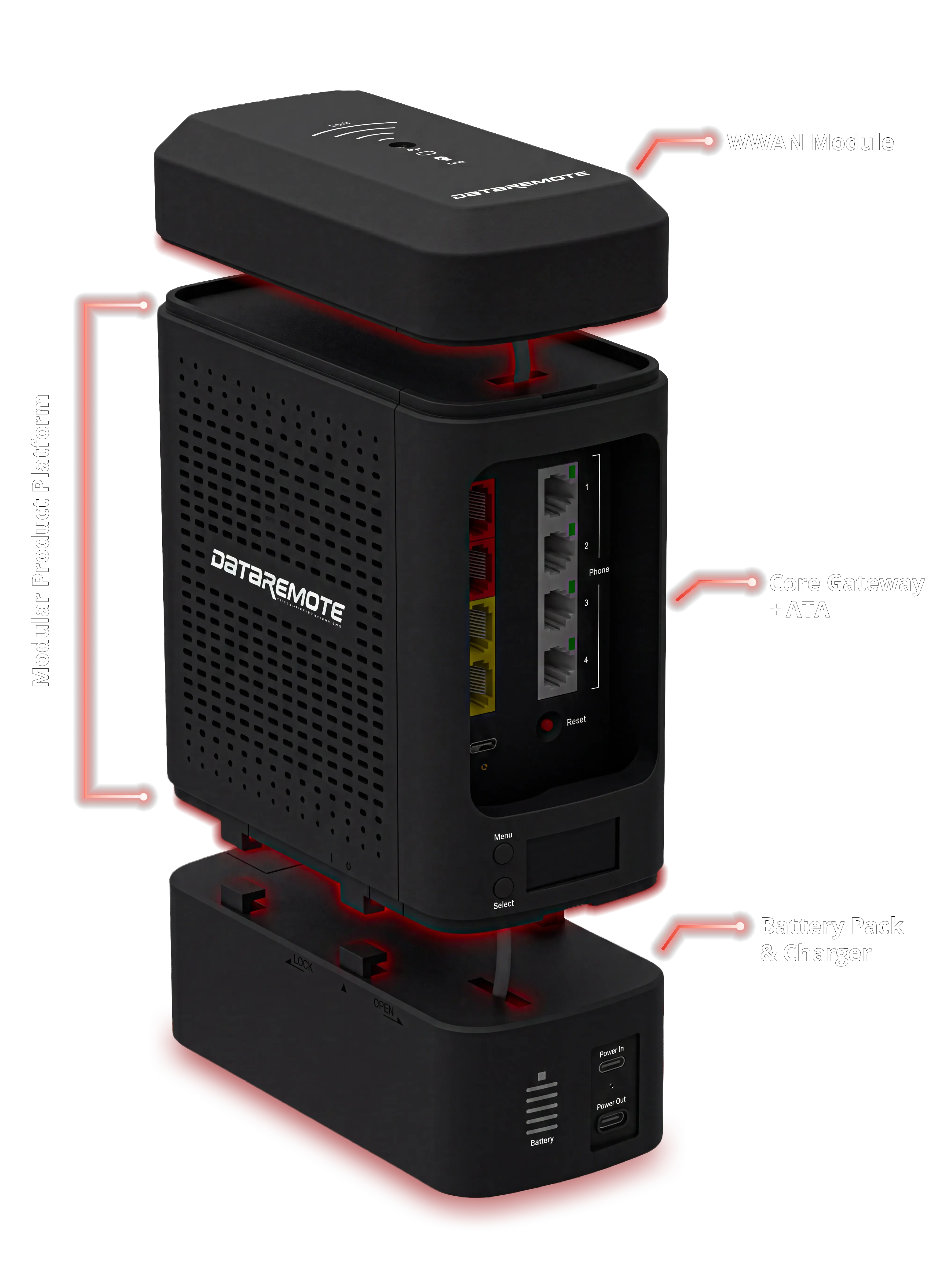
POTS IN A BOX® does a different job. It replaces one analog phone line at the edge of a building and presents dial tone to the phone, alarm panel, fax machine, or modem already plugged in. The idea is the same one the FAA is applying (keep the equipment, emulate the circuit it expects), but the circuits are a different kind, and a line-replacement appliance is not a router for an air traffic control network.
Where DataRemote works is at the other end of the same transition: the analog endpoints that still depend on a copper line the carrier intends to shut off. Airports have plenty of them, from elevator emergency phones in terminals and parking structures to fire alarm panels and the monitoring lines for airfield and obstruction lighting. So do hospitals, campuses, banks, and retail chains.
Here is how the design maps to the lessons above.
| Lesson | How POTS IN A BOX® applies it to a single line |
|---|---|
| Keep the endpoint, change the path | The appliance presents a standard analog line on RJ-11 ports, so the existing phone, panel, or fax plugs in unchanged while the call travels over managed LTE or 5G. |
| Independent path | Cellular service does not ride the copper plant being retired. The VAB-1 adds dual-SIM failover between carriers. |
| Backup power | An integrated battery is rated for up to 48 hours of standby on the 90X1 and 90X2, and up to 24 hours on the VAB-1. |
| The line reports its own failures | Ara, DataRemote’s device management platform, provides live line-status monitoring, alerts, and remote diagnostics. |
| Staged cutover | Sites move one at a time: install, test each endpoint, then release the copper line. |
There are limits worth stating. A cellular replacement depends on usable signal at the site, which should be surveyed before installation. Fire alarm and elevator communication are governed by codes that the local authority enforces, so the specific model and configuration have to suit the application; DataRemote publishes which certifications each model holds. And none of it removes the need to test the endpoint after the change.
What happens next at the FAA
Administrator Bedford described the El Dorado job as ordinary upkeep of the existing network, separate from the modernization program Congress funded in 2025. That program is the long-term answer. The FAA’s Brand New Air Traffic Control System fact sheet sets a goal of the end of 2028 and lists, among other items:
- 5,170 new high-speed network connections on fiber, satellite, and wireless
- 27,625 new radios
- 462 new digital voice switches
- 612 radars
Congress provided $12.5 billion in 2025. The fact sheet says another $20 billion is needed, and the numbers have grown since: the President has requested $30.1 billion, and Duffy has said he wants $50 billion.
Replacing the wire will not be the end of it. Bedford said in September that the copper-to-fiber work was expected to finish by September 2027 but would not by itself be enough to prevent future outages. A new cable still has to connect to a network designed with redundancy in mind.
What to do if your organization still runs on copper
The FAA has a multibillion-dollar program and a national spotlight. Most organizations have a phone bill nobody has audited in years. The first steps are small.
- Find the lines. Pull the carrier bills and list every analog line and what is plugged into it. The End of Copper Phone Lines covers where line audits usually find surprises and how to rank what you find by risk.
- Check the filings. DataRemote’s quarterly Copper Retirement Bulletin tracks carrier notices and the states they affect.
- Name an owner. Decide who answers for each life-safety line before it fails. When the Copper Line Goes Dark, Who’s Liable? covers leases, contracts, and insurance.
- Sequence the work. The enterprise copper sunset and POTS migration guide covers what makes multi-site replacement hard to manage and the questions to settle first.
- Cut over one tested site at a time. Use the checklist above, and keep the records.
The FAA’s network will be studied for months, and the root cause may turn out to be one setting on one router. The broader point will hold either way. Copper is being switched off whether or not the equipment on it is ready, and the organizations that come through it well will be the ones that planned the cutover instead of having it scheduled for them.
Frequently Asked Questions
According to the FAA, its legacy equipment became unstable when data began flooding the FAA Telecommunications Infrastructure (FTI) network at a rate of about 1,000 connection attempts every four to five seconds, which disrupted aircraft communications and radar feeds. The FAA's initial investigation points to two possible sources: a radio communications site in El Dorado, Arkansas, where contractor L3Harris was deploying a new router, and a radar site in Amarillo, Texas. Transportation Secretary Sean Duffy said the El Dorado work was part of switching the site from old copper wire to fiber, and news reports identify the router as a Juniper Networks unit. The root cause was still under investigation as of November 16, 2026.
About four hours and 21 minutes. The FAA says the technical problem began at approximately 3:30 p.m. Eastern on November 13, 2026, the nationwide ground stop was issued at 3:54 p.m., and air traffic resumed at 8:15 p.m. the same day. Delays and cancellations continued through the weekend while airlines repositioned aircraft and crews.
The FAA says operators canceled approximately 12,462 flights on Friday, November 13, including 9,082 cancellations by major airlines, and notes that not all of them were directly caused by the ground stop. About 3,500 aircraft were in the air when the stop was issued, and the FAA says all of them landed safely. Counts from flight-tracking services differ from the FAA's because they measure different sets of flights.
The FAA says that, based on all available evidence, it has no indication the outage was a cyberattack or the work of an outside actor. Secretary Duffy said the network came back once the work at the remote site was isolated. The FAA also says its recently introduced SMART system, a data aggregator, does not feed information into the air traffic control system and was not the cause, and the Homeland Security Secretary said there was no connection to a Microsoft outage the day before.
The router at the center of the investigation was being installed because the copper line serving that remote site was going away. Secretary Duffy said the wire was so old that it was being discontinued, so the site had to be moved from copper to fiber and from TDM to IP. The FAA says this kind of transition work has been under way for years because the old copper wires are being disconnected due to obsolescence. The equipment that became unstable was the legacy TDM network that still serves sites not yet converted.
TDM stands for time-division multiplexing, a way of carrying many channels over one dedicated circuit by giving each a fixed time slot. It is the technology behind T1 circuits and the traditional telephone network, and it typically runs over copper. Officials often call it analog as shorthand, although TDM circuits carry digital signals; what makes them legacy is that they are dedicated circuits rather than packets on an IP network. The FAA still uses TDM because converting thousands of sites takes years. FAA Administrator Bryan Bedford said the agency spends about a billion dollars a year maintaining its existing 1980s TDM network.
January 11, 2023, when a failure in the FAA's Notice to Air Missions (NOTAM) system halted departures for about an hour and 52 minutes. Before that, the only comparable event was the grounding of all flights after the September 11, 2001 attacks. The BBC reported that the November 13, 2026 ground stop was the longest since 2001.
The scale is different, but the pattern is the same. Carriers are discontinuing the copper and TDM services that elevator emergency phones, fire and burglar alarm panels, fax machines, and call boxes still depend on, and the riskiest moment is the cutover to whatever replaces the line. A replacement that is installed without testing the actual endpoint, without an independent backup path and backup power, and without monitoring can fail silently until someone needs it.
The FAA says L3Harris, its network service provider, was deploying a new router at a radio communications site in El Dorado, Arkansas. News reports identify the router as made by Juniper Networks, which Hewlett Packard Enterprise owns. An HPE spokesperson said the routers did not fail, and investigators are still determining whether the cause was the installation, the configuration, or the hardware. The FAA says it disabled a broadcasting function on the new routers and on about 60 similar routers elsewhere in its network, and both routers under investigation were sent to a lab for testing.
No. The line being replaced at El Dorado was not a phone line. It was the site's connection into the FAA's closed national network, which routes radar data, flight plans, and radio audio, and the replacement device was a network router that joins that network as a node. The failure came from how that router interacted with older equipment after it joined, not from a line that stopped carrying traffic. POTS IN A BOX does a different job: it replaces individual analog phone lines, such as those serving elevator emergency phones, alarm panels, fax machines, and airfield lighting monitors, with managed cellular service, battery backup, and remote monitoring. The ground stop is relevant because those lines are on the same retiring copper and face the same cutover risks, not because a line-replacement appliance could have stood in for the FAA's network.
Related
Products
Platform
Solutions
Definitions
Leaving copper on your schedule, not the carrier's?
Talk to DataRemote about inventorying your analog lines and moving them to managed cellular one tested site at a time.