
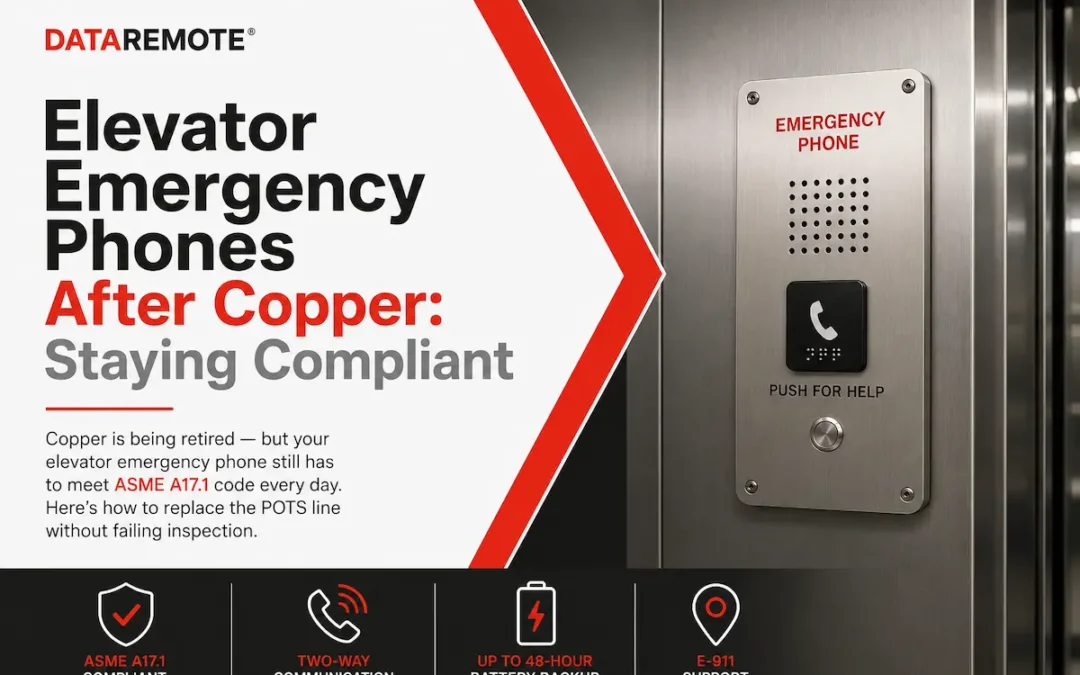
The Line Is Going Away. The Code Requirement Isn’t
For decades, the emergency phone in an elevator car rode on a copper Plain Old Telephone Service (POTS) line. Press the button, the line dials a monitoring station, and a live person answers. Simple, reliable, and — until recently — universal.
That copper is now being decommissioned. The FCC is accelerating copper retirement nationwide, AT&T has gone “wireless-first,” and other carriers like Frontier and Lumen are shutting down legacy wire centers on a rolling, region-by-region schedule. As those lines go dark, the monthly cost of the ones that remain keeps climbing while repair and support quietly disappear.
But the carrier retiring your copper doesn’t retire your code obligation. The elevator still has to have a compliant emergency communication line on the day after your copper is cut — and an inspector can fail you for a line that is not active and reliable.
What The Code Actually Requires
Elevator emergency communication in North America is governed by ASME A17.1 / CSA B44, Section 2.27.1.1. The requirements that matter most when you’re replacing an emergency elevator line are:
- A monitored, two-way connection. There must be two-way communication between the car and a monitoring location.
- Daily line verification. The system must automatically verify the line is operational continuously or at least once a day.
- Backup power. If the communication means runs on building power, it must transfer to standby/emergency power and keep the line alive for at least 4 hours after an outage. The DataRemote solution has 24 – 48 hour backup options.
Why You Can’t Just Cut The Cord
When the copper-retirement notice lands, two tempting shortcuts usually surface — and both create liability:
- Letting the line lapse. A dead emergency phone is an immediate code violation and a life-safety hazard. If someone is trapped and can’t reach help, the exposure is enormous.
- Dropping in a generic VoIP adapter. Consumer or office-grade VoIP often can’t meet the elevator-specific requirements: guaranteed daily line verification, fail-over, line-fault signaling, and hours of backup power when the building loses electricity.
This is the core message DataRemote has hammered for years: POTS replacement for life-safety lines is not just a phone swap. It’s a compliance project.
The Compliant Path: A Drop-In Proven Replacement
DataRemote’s POTS IN A BOX® replaces the copper line feeding the elevator phone with an enterprise-grade broadband connection — keeping the existing phone, the existing car panel, and your existing monitoring arrangement in place. It’s engineered for exactly the requirements above:
- Drop-in replacement — no need to swap the elevator phone or pull new permits; it presents the same analog interface the phone already expects.
- Full E-911 support — emergency calling works as required.
- Battery backup up to 48 hours plus patented UPS power output — comfortably clears the 4-hour backup-power requirement and keeps the line alive through extended outages.
- Multi-carrier, performance-based failover — monitors signal and network quality and switches carriers automatically, so the line stays up.
- UL-864 certified — built and tested for life-safety communications, not repurposed office gear.
- Proven — deployed in hundreds of thousands of locations nationwide.
Because the daily verification, monitoring connection, and backup power are all preserved, the elevator phone keeps doing everything ASME A17.1 requires — the copper underneath is simply gone.
What To Do Before Your Wire Center Shuts Down
- Inventory your elevator lines. Identify every car emergency phone and the POTS line behind it, by location.
- Confirm your monitoring arrangement. Make sure calls still land at a staffed monitoring station with the 45-second fail-over intact.
- Match each line to the right device. 90X1 (5G + LTE) for most deployments; 90X2 (4G/LTE) where 5G isn’t needed.
- Migrate before the deadline, not after the outage. Wire-center shutdowns are scheduled — but once copper is cut, the line is simply gone. Get ahead of the notice.
DataRemote can map every line to a compliant POTS IN A BOX® configuration — backup power, monitoring, and E-911 included.
Related DataRemote resources
- 90X1 (5G) POTS IN A BOX®
- 90X2 (4G/LTE) POTS IN A BOX®
- Security & Compliance Certifications
- Technical Documents (specs, guides, certs)
- DataRemote Press Coverage
Trademark notice: POTS IN A BOX® is a registered trademark of DataRemote, Inc. All other marks belong to their respective owners.
Frequently Asked Questions
Do I still need an elevator phone if the copper is being retired?
Yes. ASME A17.1/CSA B44 requires a working, monitored, two-way communication system in the elevator car regardless of the underlying line technology. Retiring copper does not remove the requirement—it means you need a compliant replacement line.
Can I replace the elevator's POTS line with cellular and stay code-compliant?
Yes. The code allows communication methods other than a traditional telephone line, including VoIP, network, and cellular connections, as long as the required daily line verification and functional requirements are maintained. A UL 864-certified cellular replacement such as POTS IN A BOX® is designed for life-safety communications.
Will I have to replace the elevator phone or the car panel?
No. POTS IN A BOX® is a drop-in replacement that provides the same analog interface the existing elevator phone expects. The phone, car panel, and monitoring arrangement can remain in place, typically avoiding a complete system replacement.
What happens to the elevator phone during a power outage?
The DataRemote 90X1 and 90X2 can provide up to 48 hours of battery backup and patented UPS power output. This exceeds the four-hour backup-power requirement referenced in ASME A17.1 §2.27.1.1.5 and helps keep the emergency communication line operating during an extended outage.
How is the line verified daily without someone calling it?
The code requires automatic verification of the communication line, either continuously or at least once per day, without requiring someone to place a manual test call. A compliant replacement monitors the connection and signals a fault when the communication path becomes unavailable.