
Our #1 solution
POTS Line Replacement
Replace the copper. Keep every analog line working.
POTS IN A BOX® moves voice, fax, alarm, and elevator lines to carrier-certified 5G/LTE without replacing the equipment on them. Savings up to 50%, up to 48 hours of battery backup, and deployments proven from Fortune 500 fleets to the VA's nationwide landline modernization.
- UL 864 certified on the 90X1, 90X2, and VAB-1
- Certified across major North American carriers
- NDAA §889 and TAA compliant hardware
Animated illustration of POTS line replacement: a fire alarm panel, elevator phone, fax machine, point-of-sale terminal, and analog phone plug into a POTS IN A BOX® appliance over their existing RJ-11 lines. The appliance carries each call over 5G/LTE or wired IP to the telephone network, the central station, and 911, keeps the lines live on battery during a power outage, fails over to cellular when the wired circuit drops, and reports line status to the Ara platform. Use the buttons below the diagram to switch scenes or pause the animation.
The fire panel reports to its central station.
UL 864 certified modelsThe panel dials over the same RJ-11 jack it always used. DTMF, line seizure, and supervision behave as they did on copper, in supported configurations.
The elevator phone reaches help, with location.
E911 with GNSSThe cab’s HELP button places a two-way call to the monitoring party. E911 carries GNSS location on supported models.
The fax negotiates and sends.
Analog signaling preservedIn-band fax and modem tones are carried the way the machine expects, so pages arrive complete instead of failing mid-handshake.
The power fails. The line does not.
Up to 48-hr batteryThe integrated battery keeps every line live for up to 48 hours, depending on model and load, while the lights are out.
The wired circuit drops. Cellular takes over.
Dual-SIM failoverAutomatic failover switches to 5G/LTE in seconds in supported configurations; dual SIM slots add carrier diversity.
Every line is visible in Ara.
Managed at scaleProvisioning, real-time line status, alerts, and remote diagnostics for the whole fleet from one dashboard.
Cost savings vs. copper
Up to 50%
See how the savings workBattery backup, up to
48 hrs
Carrier-certified network
5G / LTE
GNSS geo-location on supported models
E911
What It Does
What is POTS line replacement?
Your existing analog devices. On a modern cellular network.
POTS line replacement (also called POTS replacement) moves old analog copper phone lines to a managed cellular (5G/LTE) or wired IP connection. An on-site appliance — an integrated access device — makes the switch, so the analog devices on those lines keep working exactly as they did on copper. DataRemote's POTS IN A BOX® appliances plug your devices directly into RJ-11 ports. They preserve the analog behaviors those devices depend on (in-band voice, ring-down circuits, FAX, DTMF signaling, alarm panel communication, and E911 with geo-location) in supported configurations. No rewiring is required, and you keep your existing numbers. Each appliance arrives pre-provisioned, and most installations take minutes per line. Remote provisioning through the Ara platform means large multi-site rollouts don't require specialized on-site labor at every location. For planning timelines, costs, and compliance requirements, read the complete guide to POTS line replacement.
Content reviewed by Joseph Hill, Lead of Business Systems, Data & Automation.
Built in
What every appliance brings to the line
Advanced Voice & Call Features
Analog Data Support
Automatic Cellular Failover
High Speed Internet Access
Enterprise Device Management
Battery Backup Protection
Dual SIM Support
E911 with GNSS Location Services
Advanced Voice & Call Features
VoIP with auto-dial, voicemail, E911 support, caller ID, hold, forwarding, transfer, and conference.
Analog Data Support
Connect POS terminals, fax machines, alarm systems, elevators, and legacy modems, with no rewiring needed.
Automatic Cellular Failover
Built-in cellular backup switches over automatically, so communication keeps running when a connection fails.
High Speed Internet Access
Integrated dual-band Wi-Fi and Ethernet enables secure, high-speed data with enterprise-grade plug-and-play setup.
Enterprise Device Management
Real-time device access, robust API, live notifications and advanced security features via the Ara platform.
Battery Backup Protection
Integrated UPS battery backup provides continuous power during outages, ensuring critical communications stay online.
Dual SIM Support
Dual SIM card slots with automatic carrier failover ensuring 24/7 uptime and uninterrupted service.
E911 with GNSS Location Services
Integrated GNSS provides location reporting for E911 emergency communications on properly provisioned models and configurations.
Industry Alert
Why is copper POTS being retired — and why now?
For decades, mission-critical and life-safety devices have depended on analog copper POTS lines. The FCC counted 13.5 million traditional lines still in service in December 2025, and the network under them is being taken apart. The FCC has cut copper-retirement notice to just 90 days. In 2026 it has approved retirement across more than 30% of AT&T's copper footprint, and AT&T's retirement notices have more than tripled since 2024. AT&T is no longer accepting new copper orders as it moves toward nationwide retirement by 2029. Prices are moving just as fast. With price caps gone, carriers are repricing the lines that remain: documented rates now exceed $3,300 per month in some states. For an ordinary phone, that is an inconvenience. For a fire alarm dialer, an elevator emergency phone, or a monitored security panel, a copper disconnect removes the path a code requires. Waiting is no longer the safe or the affordable option.
Primary sources: the FCC's copper retirement and technology transitions dockets, and the section 214 discontinuance filings that govern when a carrier may stop serving a wire center. Line counts, notice volumes, and price figures are sourced in the stat cards below; the AT&T footprint approval was reported by Broadband Breakfast (Jan 13, 2026). DataRemote's quarterly Copper Retirement Bulletin tracks these figures, the states impacted, and every carrier milestone in one sourced record.
13.5M
Traditional POTS lines still in service in the U.S.
936
AT&T copper retirement notices issued in 2026
$3,300+
Documented monthly rates on remaining copper lines
13.5M
Traditional POTS lines still in service in the U.S.
The FCC counted 13.5 million end-user switched access lines in December 2025, down from 15 million six months earlier and 24 million three years earlier, a 17.9% compound annual decline. Businesses still on those lines face rising rates and shrinking support until each line is retired.
936
AT&T copper retirement notices issued in 2026
Carrier retirement notices are accelerating fast: DataRemote's Copper Retirement Bulletin reports 936 AT&T copper retirement notices in 2026, up from 240 in 2024, including 442 new notices since January 1, 2026. Once a full retirement notice is issued, customers have 180 days to move.
$3,300+
Documented monthly rates on remaining copper lines
With legacy price regulation wound down, carriers are repricing the copper lines that remain. DataRemote's Copper Retirement Bulletin documents rates climbing to more than $3,300 per line per month across 10 states, and AT&T's own filings put the average business access line at about $1,700 per month, with increases expected to continue until the lines are retired.
From Copper to Cellular
How does POTS replacement work?
A POTS line replacement migration follows four steps. Most sites are live the same day the appliance arrives. First, audit your lines. Inventory every copper circuit and what runs on it: fax machines, fire and burglar alarm panels, elevator phones, ring-downs, and POS terminals. Second, match the appliance. Choose the POTS IN A BOX® model and carrier plan certified for your device types, line counts, and cellular coverage at each site. Third, plug in. Analog devices connect to the appliance's RJ-11 ports with no rewiring. You keep your numbers, and a typical install takes minutes per line rather than days. Finally, verify and manage through Ara. Confirm dial tone and signaling on each line before you retire the copper, especially on life-safety lines. Then monitor line status, receive alerts, and troubleshoot every site remotely from a single dashboard.
- 1
Audit your lines
Inventory every copper line and what runs on it: fax, fire and burglar alarm panels, elevator phones, ring-downs, POS terminals.
- 2
Match the appliance
Choose the POTS IN A BOX® model and carrier plan certified for your device types, line counts, and coverage at each site.
- 3
Plug in, no rewiring
Connect analog devices to the RJ-11 ports and keep your numbers. A typical install takes minutes per line, not days.
- 4
Manage through Ara
Monitor line status in real time, receive alerts, and troubleshoot every site remotely from a single dashboard.
Copper POTS lines vs. POTS IN A BOX®
| Feature | Copper POTS line | POTS IN A BOX® |
|---|---|---|
| Monthly cost | Repricing upward as regulation winds down; documented rates above $3,300/month in some states | Predictable managed pricing, with savings up to 50% |
| Availability | Being retired; AT&T targets nationwide copper retirement by 2029 | Available today over certified nationwide 5G/LTE networks |
| Power outages | Central-office line power, degrading as copper plant ages | Integrated UPS battery backup of up to 48 hours |
| E-911 | Fixed street address on file | E911 with GNSS geo-location on supported models |
| Analog devices | Native support | Native RJ-11/FXS support for fax, alarms, elevators, POS, and modems |
| Life-safety compliance | Grandfathered, and at risk as lines retire | UL 864-certified models (90X1, 90X2, VAB-1) with NFPA 72 / ASME A17.1-aligned solutions |
| Management | Truck rolls and carrier tickets | Remote monitoring, alerts, and diagnostics via Ara |
Supported endpoints
Every analog endpoint. One appliance.
POTS IN A BOX® is designed to keep each of these device classes in service after its copper line is retired. Each tile says what fails when the line goes dark and links to the page that covers that endpoint in depth.
18 endpoint classes supported

Central Station Monitoring
Fire & Burglar Alarm
Keep fire and burglar alarm panels reporting to central station over a cellular path, on hardware UL 864 certified on the 90X1, 90X2, and VAB-1, as copper retires.
- UL 864
- NFPA 72

Monitored Emergency Line
Elevator Emergency Communications
Keep elevator emergency phones connected with a monitored, battery-backed cellular line designed to support elevator code requirements.
- ASME A17.1
- NFPA 72
Life safety and emergency communication
Code-governed lines that an inspector or a monitoring center expects to find working.
- Fire alarm panels Loss of the transmission path means alarms may not reach the central station, and the panel reports a trouble condition. Dedicated solution
- Burglar alarm panels Without a working path, intrusion events go unreported and monitoring lapses. Dedicated solution
- Elevator emergency phones A dead line means a trapped passenger cannot reach anyone, and the elevator can be red-tagged by an inspector. Dedicated solution
- Emergency call boxes The ring-down destination is never reached, so a call for help from a car park, campus, or platform goes nowhere. Use case
- Nurse call and panic button systems The dialer seizes a line that no longer exists, so a call for help from a bedside, a bathroom, or a teller window reaches no one, and the system may not report that it failed. Use case
- Medical alert systems (PERS) The base unit dials a line that no longer exists, so a press of the pendant or a detected fall reaches no operator, and the resident may not know the call failed. Use case
- TTY machines (text telephones) The TTY dials a line that no longer exists, or its tones are garbled by a compressed replacement path, so a typed call for help or service reaches no one or arrives as gibberish. Use case
Voice, payments, and access
The lines that take calls, authorise transactions, and open doors.
- Analog telephones No dial tone means no calls in or out from that handset. Guide
- Fax machines Fax negotiation is sensitive to timing and compression, so a poorly chosen replacement path causes failed or partial transmissions. Guide
- Point-of-sale terminals A failed line means transactions cannot be authorised and the lane stops taking payment. Guide
- ATMs Loss of connectivity takes the machine out of service and stops cash dispensing. Guide
- Intercoms Stations lose the ability to call each other or an attendant. Migration guidance
- Building-entry systems Visitors cannot reach occupants, and access control falls back to physical keys. Guide
- Gate-access systems Visitors and deliveries cannot be admitted, and residents lose remote entry control. Migration guidance
Modems, metering, and telemetry
Machine-to-machine lines whose failure is silent until the readings stop.
- Dial-up modems Modem handshakes fail on paths that alter timing or apply voice compression, taking the connected system offline. Use case
- Telemetry devices Readings stop arriving and remote control is lost, often without an obvious alarm. Guide
- Utility meters Automated reads stop, forcing estimated billing or physical site visits. Migration guidance
- Remote-monitoring equipment Faults go undetected until someone notices them physically on site. Guide
Why DataRemote
Why choose DataRemote for POTS line replacement?
From small businesses to Fortune 500 deployments, POTS IN A BOX® is carrier-certified, built for life safety, and managed from one platform. It's the appliance behind MetTel's $54 million modernization of roughly 15,000 VA landlines across 1,875 federal healthcare facilities.
Cut costs up to 50%
Predictable managed pricing replaces escalating per-line copper rates, with no surprises.
Plug & play migration
Connect analog devices to RJ-11 ports with no rewiring. Install in minutes, not days.
Built-in resilience
Up to 48 hours of battery backup and automatic dual-SIM cellular failover, depending on model, configuration, and coverage.
Government & carrier certified
NDAA §889, TAA, FCC, PTCRB, UL-listed hardware certified across major North American carriers.
Managed at scale
Provision, monitor, alert and troubleshoot thousands of lines from one dashboard via Ara.
Proven for life-safety
Deployed for fire alarm panels, elevator emergency phones, and E-911, where failure is not an option.
Ara Device Management Platform
How are thousands of replacement lines managed?
Every POTS IN A BOX® appliance is managed through Ara, DataRemote's enterprise device management platform. Provision thousands of lines at once, monitor line status in real time, receive instant alerts, and troubleshoot remotely through a single portal.
- Mass provisioning & configuration management
- Real-time line status monitoring & alerts
- Remote diagnostics and troubleshooting
- Carrier-level API for integration and automation
- Full audit log and compliance reporting

POTS IN A BOX®
Which appliances replace POTS lines?
Recommended Appliances
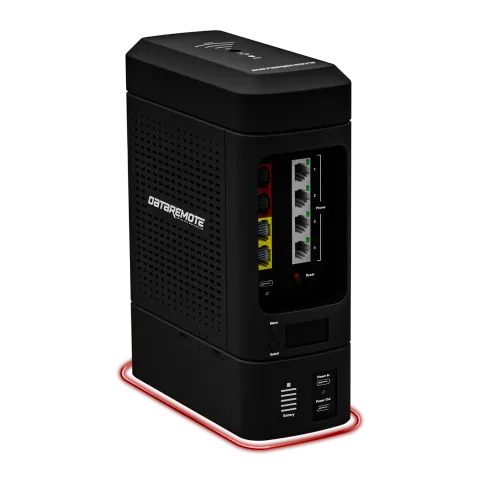 5G RedCap
90X5
Modular POTS IN A BOX® / Business Gateway Platform
Modular PIAB and business gateway platform: Gigabit Ethernet Connectivity, 5G RedCap WWAN with LTE fallback, 4-8 FXS voice lines, and swappable power/battery modules. Built for telephone line replacement, fixed wireless access, and internet backup.
 4-8 FXS
 5G RedCap
 24hr Battery
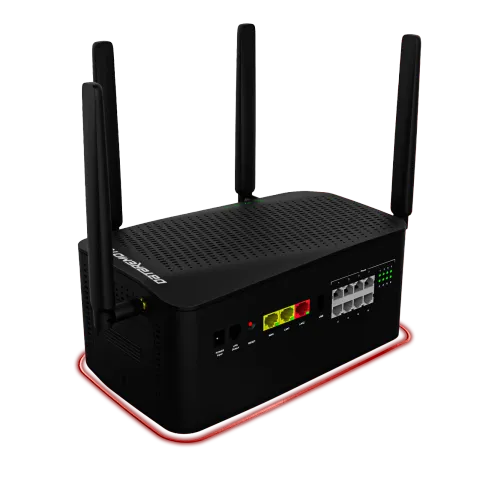 5G
90X1
5G POTS replacement with automatic internet failover
Enterprise 5G appliance that replaces up to 8 analog POTS lines with an integrated ATA. Includes 48-hour battery backup, a global 5G radio, UPS power output, and automatic cellular internet failover.
8 FXS 5G NR 48hr Battery 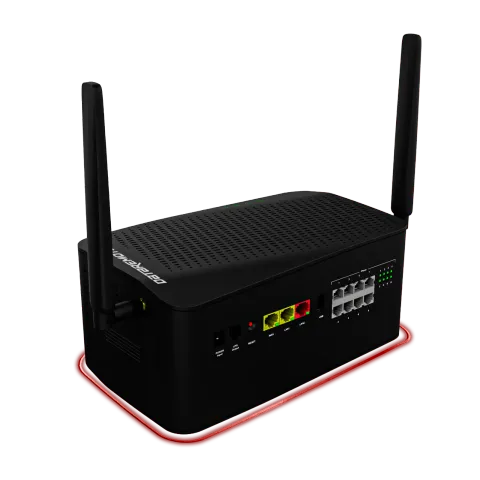 LTE
90X2
LTE POTS replacement with automatic internet failover
The LTE sibling of the 90X1. It replaces up to 8 analog POTS lines with an integrated ATA and adds patented UPS power output, 48-hour battery backup, and automatic cellular failover on North American LTE bands.
8 FXS  LTE 48hr Battery
Solutions
Purpose-built for the lines that can't go dark
Business continuity
Internet Backup & Cellular Failover
24–48 hour battery backup and instant, zero-touch cellular failover keep your business online the moment your primary connection drops.
Solution
Fixed Wireless Access
Primary or failover business internet over 5G/LTE, with automatic failover and battery backup baked in.
Learn more
Solution
Elevator Emergency Communication
Keep elevator emergency phones connected and inspection-ready as copper POTS lines retire.
Learn more
Video
See it in action
90X1 5G POTS Line Replacement — Video Overview
See how the 90X1 replaces analog copper POTS lines over 5G: 8 FXS ports, up to 48-hour battery standby, and E-911 support, managed through Ara.
Watch with transcript (1:47)Hotline & Ring-Down Feature — Video Explainer
How POTS IN A BOX® preserves hotline and ring-down (auto-dial) behavior: the off-hook circuits emergency phones and call boxes depend on.
Watch with transcript (0:46)Replace Your Landline with POTS IN A BOX® — Video
A one-minute look at how POTS IN A BOX® replaces copper landlines: analog devices plug into RJ-11 ports and keep working over managed cellular.
Watch with transcript (0:55)POTS Line Replacement FAQs
What is a POTS line?
How does DataRemote replace a POTS line?
What is the difference between POTS replacement and VoIP?
How long does a POTS line replacement installation take?
How much can POTS replacement save?
Is cellular reliable enough for life-safety lines?
Ready to replace copper before your carrier does it for you?
Talk to a DataRemote specialist about a migration plan for your sites, lines, and timeline.